
Skip to content
Alternatives GuideUpdated

10 Best Operandio Alternatives for Franchisors in 2026

Multi-unit and franchise teams evaluating alternatives to Operandio typically prioritize three things: a corrective action that reaches retraining rather than stopping at a task, reporting they can act on, and franchise structure modeled natively instead of configured. Delightree is the leading alternative for franchise operations. FranConnect suits brands that also need franchise development, while Crunchtime Ops Execution is designed for enterprise restaurant chains, and Jolt for food safety hardware.

  1. Best Overall Alternative

    Delightree

  2. Best for Franchise Development Alongside Operations

    FranConnect

  3. Best for Enterprise Restaurant Chains

    Crunchtime Ops Execution

  4. Best for Facilities and Maintenance

    Xenia

Joseph Ortega

Written by Joseph Ortega, Digital Growth Marketing Lead at Delightree

Before Delightree, he worked in franchise marketing at CorePower Yoga, Sola Salon Studios, and Fortidia's PostNet and AlphaGraphics brands, where he worked closely with operations teams to support large franchisee networks and keep every location on brand.

LinkedInPublished Updated

You already digitized daily operations. You decided that years ago, and Operandio has been doing the work.

But now you’re wondering: Why do the same findings keep coming back? A location fails the same item in Q1, Q2 and Q3. The checklist was completed. The inspection was logged. The finding was written up. And nothing changed.That’s because nothing in the system was ever going to force a change.

That is the issue this guide is built around, because you need to determine whether you need a different checklist tool or a different product category entirely. If your problem is that the audit is clunky or the reporting is thin, a better execution tool could be the fix and several are listed below.

If your issue is that findings get filed but not fixed, there isn’t any checklist tool of any quality that solves that.

One thing to be fair about upfront: Operandio is a broad multi-unit operations platform, not a checklist app, and it has 4.9 stars from 22 reviews on Capterra. Alongside checklists for food safety and inspections, it runs a searchable knowledge base, a mobile-first learning management system with quizzes, badges, pathways and certificates, an AI course builder, a Location LaunchPad for new location openings, supplier management tools, and FranchiseLab for franchisee recruitment. It scores 6.8 against our franchise operations rubric, mid-table in the wider category and ahead of most of the tools on this page. This is not a guide addressing a problem with a bad product. It is a guide about franchise fit.

What Are the Best Alternatives to Operandio? Competitor Comparison and Ratings Chart

  1. #1 Delightree

    Best Overall Alternative

    9.3/10

    Best For
    Best Overall Alternative
    vs. Operandio
    Adds franchisee support tickets and franchise-first permissions
    Franchise Native
    Yes, four-tier
    Price Model
    Per location, unlimited users
  2. #2 FranConnect

    Best for Franchise Development Alongside Operations

    7.5/10

    Best For
    Franchise development
    vs. Operandio
    Adds development and royalties, weaker frontline
    Franchise Native
    Yes
    Price Model
    Per module, custom quote
  3. #3 Crunchtime Ops Execution

    Best for Enterprise Restaurant Chains

    6.7/10

    Best For
    Enterprise restaurant chains
    vs. Operandio
    Deeper rollout control at much larger scale
    Franchise Native
    No
    Price Model
    Custom, tier and form count
  4. #4 Xenia

    Best for Facilities and Maintenance

    6.4/10

    Best For
    Facilities and maintenance
    vs. Operandio
    Adds work orders, assets and escalation
    Franchise Native
    No
    Price Model
    Per user or per site
  5. #5 Jolt

    Best for Food Safety Hardware

    6.3/10

    Best For
    Food safety hardware
    vs. Operandio
    Adds labels, probes and sensors, narrower scope
    Franchise Native
    No
    Price Model
    Per location
  6. #6 SafetyCulture

    Best for Inspection-Led Programs

    5.9/10

    Best For
    Inspection-led programs
    vs. Operandio
    Broader inspection depth, generic not franchise
    Franchise Native
    No
    Price Model
    Per user
  7. #7 Lumiform

    Best for Audit-First Compliance Reporting

    5.8/10

    Best For
    Audit-first compliance reporting
    vs. Operandio
    Simpler and more predictable, narrower scope
    Franchise Native
    No
    Price Model
    Tiered, base plan inclusive
  8. #8 Connecteam

    Best for Comms and Scheduling With Tasks

    5.7/10

    Best For
    Communications and scheduling with tasks
    vs. Operandio
    Adds scheduling, loses operational depth
    Franchise Native
    No
    Price Model
    Per user, tiered by seat
  9. #9 Ladle (MeazureUp and ComplianceMate)

    Best for Field Audits and Food Safety Monitoring

    5.6/10

    Best For
    Field audits and food safety monitoring
    vs. Operandio
    Similar audit depth, added temperature monitoring
    Franchise Native
    No
    Price Model
    Per feature
  10. #10 GoAudits

    Best for Budget Inspections

    4.9/10

    Best For
    Budget inspections
    vs. Operandio
    Cheaper and lighter, inspections only
    Franchise Native
    No
    Price Model
    Per user, from $12

Data current as of August 2026.

Why Multi-Unit Teams Look for an Operandio Alternative

The reasons teams make the switch from Operandio are drawn from patterns in public review data and from documented product scope. Operandio’s 4.9 stars on Capterra is a strong score, and the reasons brands leave are mostly related to what the product does not cover and not shortcomings on what it does cover.

  1. No franchisee-to-HQ support ticket routing

    Operandio routes corrective actions well, and a failed inspection creates a follow-up. What it does not have is a support ticket channel running the other way, from the franchisee up to the responsible person at franchisor headquarters. In practice, that means the questions and escalations franchisees raise every day arrive by phone, email and text instead of as tracked, routed, auditable tickets. HQ cannot see which locations are asking for help, what they are asking about, or how long anyone waited, so the support burden stays invisible and unmeasured while the operations data is fully tracked.

  2. Reporting maturity lags the execution layer

    This is the most consistently cited limitation across competitor analyses and operator evaluations. The analytics and dashboard layer is less developed than the task and inspection layers it reports on. For a brand running a handful of locations, that is tolerable. For a brand trying to work out which locations are drifting and why, thin reporting means the answers are not clear even though the data exists.

  3. Built hospitality-first for multi-site, not franchise-native

    Operandio serves corporate chains, hotels and gyms alongside franchise brands, and its positioning reflects that breadth. It has also been extending further into franchising. In February 2026, it acquired FranchiseLab, the franchise recruitment tool built on Greg Nathan’s Nathan Profiler methodology, which has around 100 franchise customers across Australia and New Zealand.

    What a franchise brand needs is franchisor and franchisee modelled as structurally different parties, with corporate locking brand standards while franchisees manage their own locations and staff, and with joint-employer considerations shaping who assigns what. On a platform built for multi-unit operations generally, that separation is configured rather than inherited, and it has to be rebuilt every time you restructure a region or add a brand. Operandio is not failing at franchising. It was built for multi-site operations, which is a related but different shape of company.

How We Evaluated These Operandio Alternatives

We assessed 10 platforms during August 2026 using published pricing and product documentation, verified review data on G2 and Capterra, product tours where available, and the questions multi-unit operators raise during vendor evaluations.

Our Scoring Methodology

  1. Franchisee and Frontline Adoption25%

    Whether the person in the location opens it. Mobile experience, offline behavior, login friction, and whether HQ can see who is not using the tool.

  2. Operational Breadth in One System20%

    How much of the operating day lives in one place: SOPs, training, tasks, audits, communications, reporting.

  3. Integration Depth15%

    Native connections to POS, booking, HRIS, payroll and accounting, versus middleware, versus no integration.

  4. Location Opening and Rollout15%

    Whether the platform can run a phased opening program, and what happens to the location after go-live.

  5. Compliance and Audit Trail15%

    Scored audits, corrective actions, retraining triggers, and a record that survives a regulator or a third-party auditor.

  6. Pricing Model and Transparency10%

    Published pricing, what is gated, and what happens to the bill as locations and headcount grow.

Top 10 Operandio Alternatives and Competitors in 2026

Our Top Pick
Ranked #1

Delightree

Best Overall Alternative

Franchise Ops Score: 9.3/10

Delightree is the franchise operations platform behind 150+ franchise brands, including Tony Roma’s, L&L Hawaiian Barbecue, Clean Eatz, Sandbox VR and Slick City. Both platforms run checklists, audits, training and a knowledge base, so the difference is not the module list. It is that Delightree is built only for franchising. Franchisor, franchisee, manager and frontline are four native permission tiers rather than a configuration, franchisees can raise support tickets that route to the responsible person at HQ, and the AI search layer over approved brand content is one of the more refined implementations in this category.

Best for: franchise brands of roughly 10 to 300 locations that already run a checklist tool and keep seeing the same findings repeated, or that operate outside food service and are hitting hospitality assumptions.
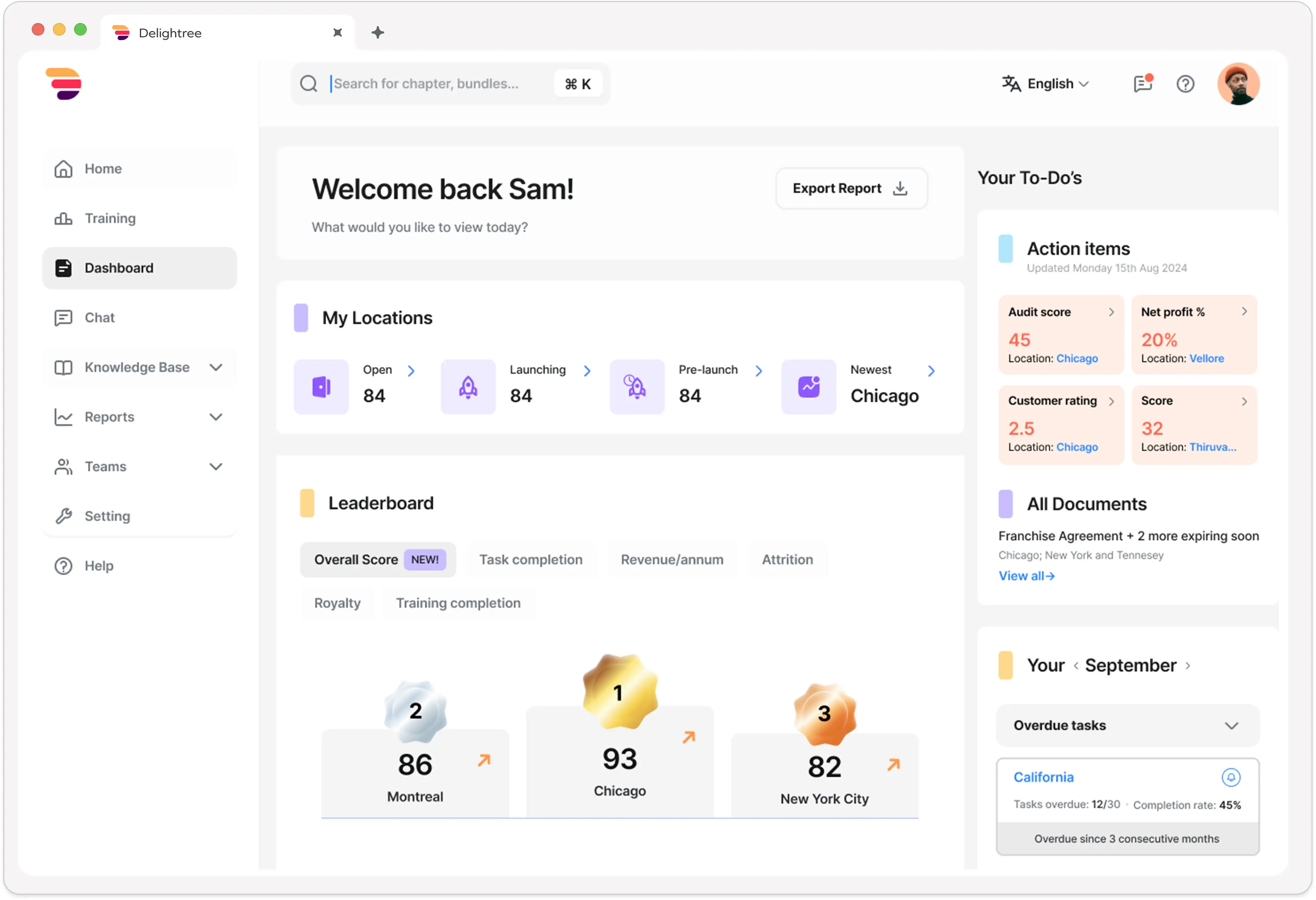
Delightree location dashboard

Product Overview

  1. Pain: The same finding comes back every quarter

    Your inspection program is working. Findings are captured, corrective actions are assigned, tasks get closed. And the same item fails again at the same locations, because closing a task fixes the instance but doesn’t address the root of the problem. The training gap that produced the issue was never touched, and nothing in a checklist tool was ever going to touch it.

    Solution: The finding, the corrective task and the retraining live in one system

    A failed audit item becomes a corrective action task with an owner and a deadline. From the audit screen, the franchisor can assign the relevant training module to that location’s team, raise a support ticket if the cause is equipment or supply, and trigger a follow-up visit to verify the fix. The standard the location failed on lives in the same Knowledge Base the training is built from, so when the standard is updated, the audit criteria and the course reference stay current from one source. L&L Hawaiian Barbecue runs 170+ mainland audits monthly through the mobile app.
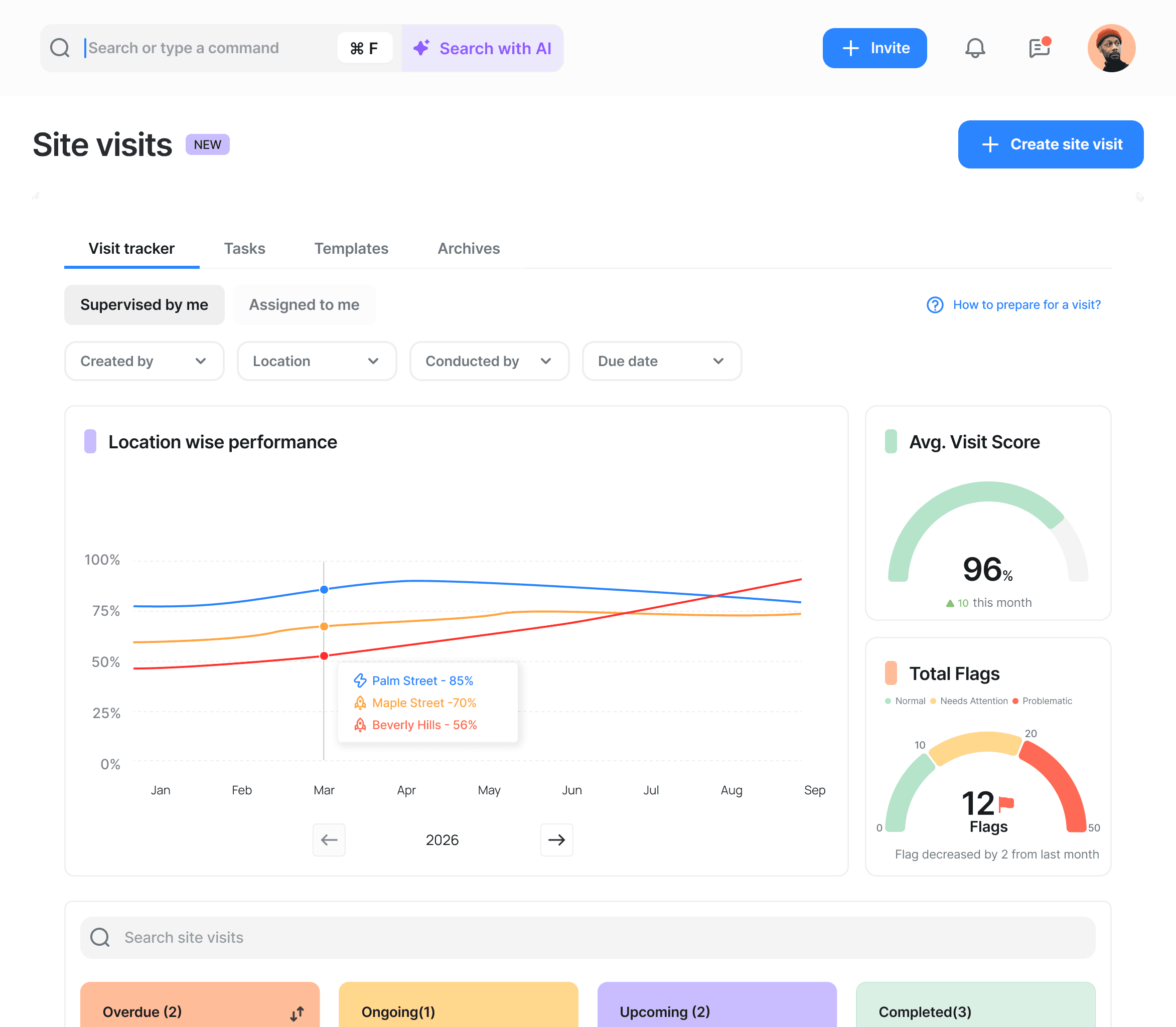
    An audit finding creating a corrective task in Delightree
  2. Pain: The checklist tells someone what to do, not how or why

    A shift lead hits a step they have not done before, or a situation the checklist did not anticipate. There is no answer inside the tool, so they message the area manager, guess, or skip it. The standard operating procedure that would have the answer is in a drive folder nobody opens.

    Solution: A searchable brand knowledge base behind the checklist

    Every SOP, policy, and brand standard sits in one Knowledge Base, and AI Search answers a question from that approved content, scoped to the asker’s role and location, returning the source document rather than a generic answer from the open internet. Beem eliminated its "I can’t find it" support emails after enabling it.
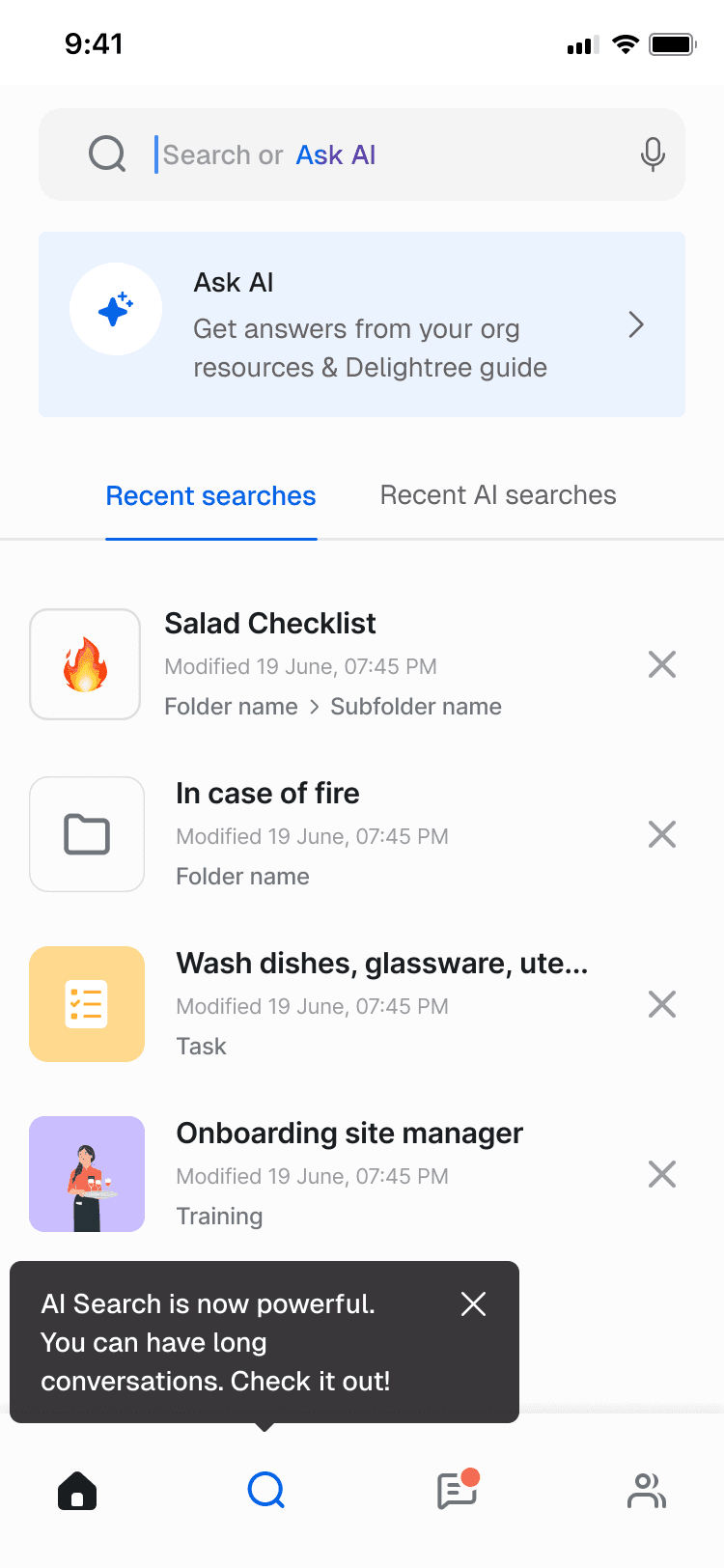
    Delightree AI Search returning an answer with its source
  3. Pain: The opening program and the running location live in different places

    Both platforms cover new location openings, so the question is not whether the capability exists but what happens at the handover. An opening program that tracks pre-opening tasks and then hands the location to a separate operating rhythm loses the thread at exactly the moment it matters, because the team that just learned the standards during launch is the same team running service the next morning. A delayed or poorly handed-over opening costs thousands of dollars a week in missed royalties.

    Solution: A phase-gated opening program on the platform the location keeps running on

    Location Launcher turns each opening into a phase-dependent playbook with training, SOPs and compliance gates built in, and the next phase unlocks only when the opening team finishes the current one. The location then keeps running on the same platform from Day One, on the same SOPs and the same training it was launched with, so nothing is handed over and nothing is re-learned. Tony Roma’s replaced weekly spreadsheets and status calls with real-time launch visibility.
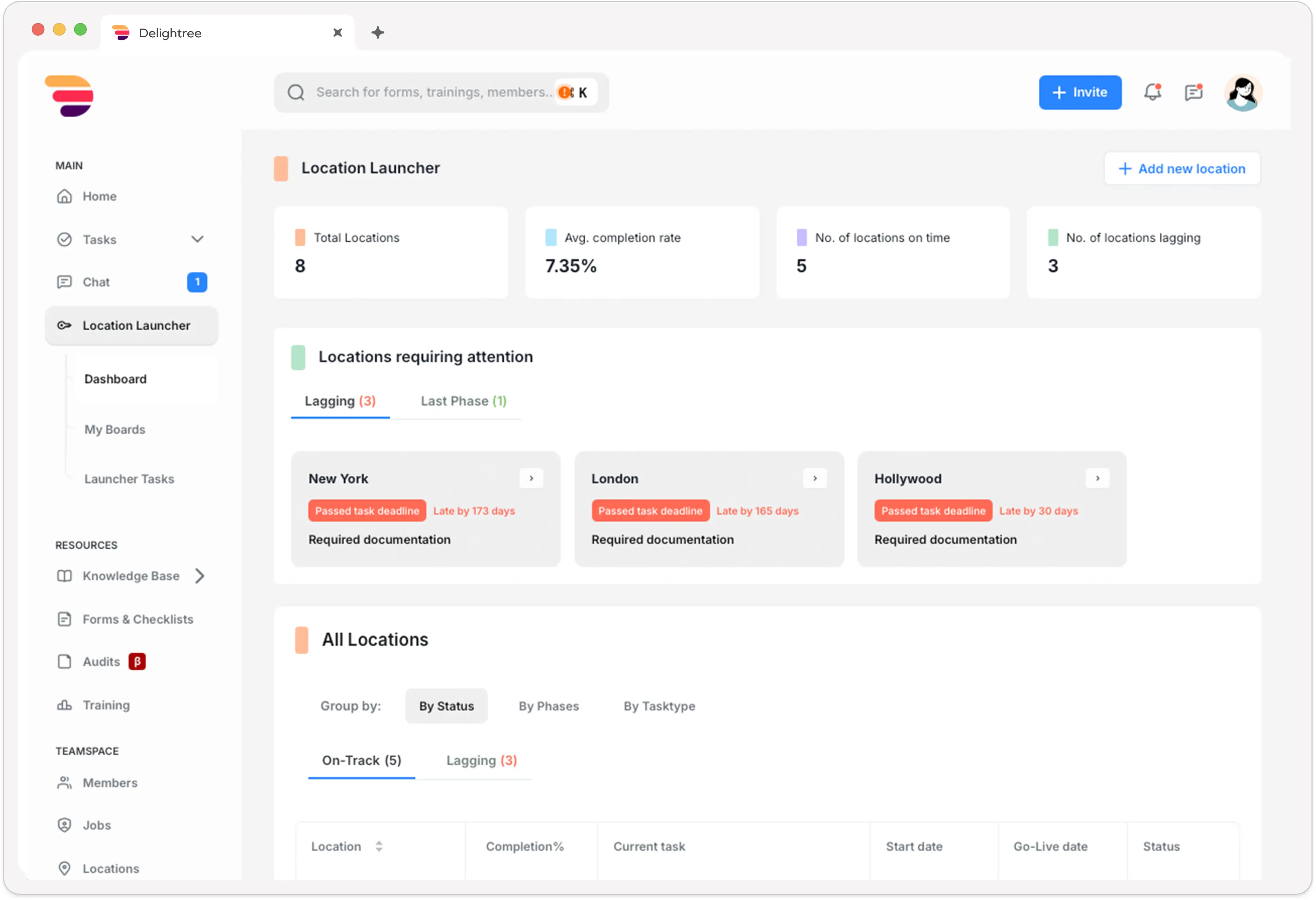
    Delightree Location Launcher phase gates

Interactive Product Demo

About 3 minutes, no form. Open the full tour

Pricing

Flat rate per location with unlimited users, every HQ and corporate seat included. Against Operandio, this is the clearest structural difference, because Operandio prices on a combination of locations, users and modules, and the per-user component is what makes broad frontline access expensive. Delightree does not publish list prices and quotes each network individually.

Integrations

Confirm coverage directly against your own stack. The connections that matter are the point of sale or booking platform feeding unit performance, human resource information systems and payroll for roster and role changes, and accounting.

Setup

Scope depends on network size, but you do not start from zero. Existing SOPs, checklists, training content, and location structure come into Delightree during onboarding, handled by Delightree’s own Customer Success team.

Delightree publishes a 30-day rollout framework built around early activation milestones, daily usage monitoring, and identifying who has not logged in within 48 hours. If you are already running a checklist tool, your templates are the migration, so scope that specifically.

Tradeoffs

Delightree is a franchise operating system, which means it is broader than Operandio and less specialized in places.

Temperature monitoring is logged rather than captured passively from wireless probes and sensors, which Jolt and Crunchtime both offer natively. There is no inventory, food cost or labor scheduling. Multilingual delivery is limited. It does not run franchise sales, royalties or FDD workflows, so it is not a FranConnect replacement either.

Support

Every network gets white-glove onboarding and a dedicated account manager. Erin Render, CEO of Legato Living, says "The onboarding process was a breeze due to the support of the Customer Success team! It wasn’t a matter of overselling and under-delivering like we’ve experienced in the past."

Mini Case Study

Slick City replaced five separate tools with one system and built a repeatable opening process as it scaled past 32 territories.

“Having documented daily checks that are completed and cleaning tasks that are documented has been a game changer. We can audit what’s been done or not been done, and from a risk standpoint, it’s been critical.”
Wade Powell, Chief Operating Officer, Slick City
Read the full case study

See how Delightree helps multi-location teams run their day-to-day operations. Try the workflow yourself without filling out a form, or book a demo tailored to how your brand operates.

Book a Demo
Ranked #2

FranConnect

Best for Franchise Development Alongside Operations

Franchise Ops Score: 7.5/10

vs. Operandio: Adds development and royalties, weaker on frontline adoption.

FranConnect is on this page for a specific reader: a brand that concluded the answer is a different product category, not a better checklist tool, and that also needs franchise sales and royalties handled. It serves 1,500+ franchise and multi-location brands across four product lines, and it is the only alternative here that touches the development side at all.

Product Overview

Franchise sales CRM with Item 23 receipt handling, franchisee onboarding, royalty calculation and collection, FDD and compliance document management, field visit and audit modules, an opener module, and embedded training through World Manager. It covers more of a franchisor back office than anything else in this guide.

Pricing

Custom quote, priced by module and system size, with no published list price and no free tier. If Operandio’s module-based quoting is one of your reasons for leaving, note that FranConnect reproduces it at a larger scale.

Integrations

Broad and enterprise-grade with an API, across POS, accounting and marketing systems. Stronger than anything else on this page.

Setup

Months, typically requiring a dedicated project team. Substantially heavier than the Operandio implementation.

Tradeoffs

Frontline adoption is the recurring complaint, which is awkward if adoption is not currently your problem. One customer described the field-communication module as "a graveyard, nobody logs in," and FranConnect has 4.3 stars from 209 reviews on Capterra with ease of use at 4.2 and value for money at 4.2, both below customer service at 4.5. The audit loop also stops where Operandio’s does. Findings create tasks, but retraining and verification live in a separate module. You would be solving the development gap and inheriting a frontline problem.

Ranked #3

Crunchtime Ops Execution

Best for Enterprise Restaurant Chains

Franchise Ops Score: 6.7/10

vs. Operandio: Deeper rollout control at much larger scale.

Crunchtime Ops Execution, formerly Zenput and acquired by Crunchtime in June 2022, is the enterprise version of what Operandio does. It supports over 150,000 locations across more than 100 countries, with brands including Chipotle, P.F. Chang’s, Gong cha and Tacala Companies across 300+ Taco Bell locations. If you are outgrowing Operandio upward, this is the direction.

Product Overview

Operational program rollout at scale, recurring task assignment, food safety routines and line checks, location audits with scoring, and execution visibility by region. Wireless temperature monitoring is available natively. It works best inside the broader Crunchtime suite alongside inventory and labor forecasting.

Pricing

Custom quote only, on a tier and form-count model. Third-party sources report a starting point around $40 per month per location, but real pricing depends on locations, form counts and requirements. The form-count element is the one to model, because more locations equals more forms and a higher tier.

Integrations

Deep within the restaurant stack with strong POS coverage, and the broader Crunchtime suite if you take it.

Setup

Months, with the longest sales cycle on this page. This is enterprise procurement, not a rollout.

Tradeoffs

Since the acquisition, reviewers have mentioned roadmap direction, request handling delays and product update pace. It is built for corporate chains rather than franchise structures, so franchisor-to-franchisee permissioning gets configured by hand. There is no location opening program, no knowledge base with search and no integrated LMS, so the finding-to-retraining gap that may be driving your search is not solved here either. Substantially heavier than a network below roughly 20 locations needs.

Ranked #4

Xenia

Best for Facilities and Maintenance

Franchise Ops Score: 6.4/10

vs. Operandio: Adds work orders, assets and audit escalation.

Xenia is an operations and maintenance platform for deskless teams, and it is the strongest option here if your operational problem is as much physical as procedural, including equipment-heavy fitness studios, car washes, or restaurants where kitchen assets drive the findings. It also markets the deepest audit scoring mechanics on this page.

Product Overview

Inspections and audits with photo evidence, recurring task scheduling, work order management, preventive maintenance and asset tracking, and issue reporting with corrective follow-up. Xenia markets weighted audit scoring with 10-point critical and one-point cosmetic items, conditional visibility for store-format variation, nullify scoring so a smaller format is not marked down for equipment it never had, and corrective-action escalation from district manager to regional to corporate.

Pricing

Supports both per-user and per-site pricing, with published entry pricing reported around $99 per month. Ask specifically about the per-site option, because per-user reproduces the cost pressure you may be leaving.

Integrations

Moderate with an API. Thinner on franchise-specific systems.

Setup

Days to weeks. One of the faster deployments here, which matters if you are switching mid-contract.

Tradeoffs

Xenia has 4.9 stars from 23 reviews on Capterra, a strong score on a thin base. It is a general multi-site operations and maintenance tool rather than a franchise platform. It has no franchisor-to-franchisee hierarchy (so franchise permissioning gets rebuilt by hand), no training system, no brand knowledge base with search, and no location opening program. If your reason for leaving Operandio is the finding-to-retraining gap, Xenia has better audit mechanics and the same structural gap.

Ranked #5

Jolt

Best for Food Safety Hardware

Franchise Ops Score: 6.3/10

vs. Operandio: Adds labels, probes and sensors, narrower software scope.

Jolt is a tablet and mobile operations platform for restaurants and food service, used by over 300,000 workers globally with more than 700 million tasks completed. Clients include McDonald’s, Smoothie King, Jimmy John’s and Buffalo Wild Wings. It is the most hardware-native option here, and that is the specific reason to choose it.

Product Overview

Recurring checklists, opening and closing routines, digital food safety logs, date labeling, wireless temperature probes and sensors with alerting, forms, and time and attendance. Passive temperature capture removes the human step entirely, which is a genuine advantage over a logged reading.

Pricing

Per location, quote-based, with no published list price and no free trial listed.

Integrations

Common POS and scheduling tools, plus its own label printer and probe hardware ecosystem.

Setup

Weeks. Most operators find the interface simple enough for hourly staff with minimal guidance, though configuring across many locations takes real initial time.

Tradeoffs

Jolt has 4.4 from 116 reviews on G2 and 4.6 on Capterra, and G2 reviewers rate it below 7shifts on ease of use, setup and admin. There are recurring service complaints in the review base, including a Capterra reviewer citing false promises and poor service.

Structurally, it is narrower than Operandio, not broader. There is no franchise hierarchy, no integrated training, no knowledge base, no location opening program, and no corrective action loop reaching retraining. You would gain hardware and lose software scope.

Ranked #6

SafetyCulture

Best for Inspection-Led Programs

Franchise Ops Score: 5.9/10

vs. Operandio: Broader inspection depth, generic rather than franchise.

SafetyCulture, formerly iAuditor, is the category leader in digital inspections, used well beyond hospitality across construction, manufacturing and retail. If your program is inspection-led and you want more depth and a bigger template library than Operandio offers, this is the most logical swap.

Product Overview

Mobile inspections with photo evidence and conditional logic, scored audits, corrective action assignment, offline capture, a large template library, sensors and analytics. Following the EdApp acquisition, it also carries a training product, which makes it broader than a pure inspection tool.

Pricing

Per user, which is the structural problem at multi-unit scale. The bill climbs with every frontline worker you add. A free tier exists for small teams.

Integrations

Broad general-purpose integrations, plus an API. Thinner on restaurant-specific systems than Crunchtime or Jolt.

Setup

Days to weeks. The template library shortens setup considerably, and migrating inspection forms is more straightforward here than most.

Tradeoffs

It is a general-purpose compliance platform rather than a franchise or hospitality platform, so there is no franchisor-to-franchisee hierarchy and franchise permissioning gets rebuilt by hand. There is no location opening program and no brand knowledge base with search. The training layer arrived by acquisition rather than as a native part of the operating loop, so the finding-to-retraining connection is looser than it may first appear. Per-user pricing works directly against broad frontline access.

Ranked #7

Lumiform

Best for Audit-First Compliance Reporting

Franchise Ops Score: 5.8/10

vs. Operandio: Simpler and more predictable, narrower scope.

Lumiform is a mobile-first inspection and audit platform built for frontline operations, covering the full inspection life cycle from form creation through corrective actions to audit-ready reporting. It positions itself explicitly against Operandio on simplicity, fewer modules, faster deployment, less administrative complexity.

Product Overview

A no-code AI form builder that can start from scratch, from templates, or from an uploaded PDF or spreadsheet, offline mobile access with automatic sync, automated corrective action routing based on inspection result and severity, and trend analysis across sites in real time. Notably, capabilities other platforms gate behind add-ons are included in the base plan.

Pricing

Tiered with the base plan more inclusive than most, which makes it one of the more predictable options here to budget.

Integrations

Moderate. Verify against your POS, HRIS and payroll stack.

Setup

Fast. Lower administrative complexity than Operandio is the pitch, and form migration from an existing tool is one of the better-supported paths here.

Tradeoffs

The scope is narrower than Operandio by design, so if you use Operandio’s communications, knowledge base, LMS or Location LaunchPad you would be giving those up. No franchise hierarchy, no location opening program, no brand knowledge base with search and no training system. Choose it if your problem is that Operandio is too much and reporting is too thin, not if your problem is that it does too little.

Ranked #8

Connecteam

Best for Comms and Scheduling With Tasks

Franchise Ops Score: 5.7/10

vs. Operandio: Adds scheduling and communications, loses operational depth.

Connecteam is a mobile-first workforce app bundling scheduling, time tracking, communication, checklists and light training. Teams leaving Operandio land here when the real requirement turns out to be workforce management rather than operational compliance, and when a free tier is attractive during a budget freeze.

Product Overview

Shift scheduling, GPS time tracking with payroll-ready timesheets, team chat and announcements, forms and checklists, task management, and an HR and training hub with AI-assisted course creation. Frontline adoption tends to be strong because it was built for phones first.

Pricing

Free Small Business plan for up to 10 users. Paid plans start at $29 per month for up to 30 users, with Advanced at $49 and higher tiers reaching $99. Tiered by seat count, which becomes the constraint across a multi-unit network.

Integrations

Payroll and HR systems. Thin on POS, booking and franchise-specific systems.

Setup

Days. The fastest deployment on this page and no implementation project.

Tradeoffs

Moving here from Operandio is a downgrade on operational depth and an upgrade on workforce management. There is no scored brand audit program with corrective actions, no franchise hierarchy, no location opening program, no knowledge base with search, and the training module is light rather than a real LMS. Reviewers note essential features often require an upgrade and mid-market organizations cite cost concerns as seat counts scale.

Ranked #9

Ladle (MeazureUp and ComplianceMate)

Best for Field Audits and Food Safety Monitoring

Franchise Ops Score: 5.6/10

vs. Operandio: Similar audit depth plus temperature monitoring hardware.

Ladle is a suite for multi-location food service, restaurant, grocery and convenience operators, combining MeazureUp for field audits, ComplianceMate for food safety monitoring, and Storewise. For a brand whose Operandio use is mostly field audits plus temperature compliance, it covers the same ground with dedicated products behind each half.

Product Overview

Digitized store walks, brand audits and operational inspections with mobile execution, evidence capture and scoring through MeazureUp. Corrective action plans assigned from findings and tracked to closure. Food safety monitoring including temperature hardware through ComplianceMate. Multi-unit visibility to spot patterns by site or region.

Pricing

Per feature, with third-party sources reporting Capterra listings from around $20 per feature per month. The per-feature structure is worth modelling carefully at scale.

Integrations

Moderate, weighted toward the food service and convenience stack.

Setup

Weeks. Two products means two configurations if you take both halves.

Tradeoffs

It is a suite of point products rather than one platform, so you are buying the same fragmentation you may be trying to escape, just from one vendor. There is no franchise hierarchy, no location opening program, no integrated LMS and no brand knowledge base with search. Best suited to food and convenience operators specifically, so a nonfood franchise hits the same vertical assumption problem it may be leaving Operandio over.

Ranked #10

GoAudits

Best for Budget Inspections

Franchise Ops Score: 4.9/10

vs. Operandio: Cheaper and lighter, inspections only.

GoAudits is a mobile inspection platform serving 50,000+ professionals across 70 countries, built around one workflow done well. Complete a checklist, generate a branded PDF report automatically. It is the budget option here, and it is honest about its scope.

Product Overview

Digital checklists with conditional logic, photo annotation and digital signatures, automated branded PDF reports generated after each inspection with scores and flagged items, and task assignment from failed items with an assignee and deadline. Report generation speed is the genuine differentiator.

Pricing

Per user, with a Starter tier reported around $12 per user per month covering 25 locations and 10 templates. Cheap at small scale and increasingly expensive as the frontline grows.

Integrations

Limited. Verify anything you depend on before committing.

Setup

Days. The lightest implementation on this page.

Tradeoffs

GoAudits has 4.8 stars from 144 reviews on Capterra, a good score on a reasonable base, but the scope is much narrower than Operandio. There is no franchise permission hierarchy, no training system, no knowledge base, no task management beyond inspection follow-ups, and no location opening program, so nothing connects an audit finding to the SOP or the training that would fix it. An inspection produces a PDF and the finding stays there. If repeat findings are why you are shopping, this is the wrong direction.

How We Built This Guide

The reader here is not deciding whether to digitize operations. They’re asking if the problem is the tool, or the category.

This guide is for Vice Presidents and Directors of Operations, Chief Operating Officers and founders at multi-unit and franchise brands of roughly 10 to 300 locations, weighted toward restaurant, quick-service restaurant and food-adjacent concepts where Operandio is strongest, plus large multi-unit franchisees running a meaningful share of a network.

How to Choose the Right Operandio Alternative

  1. Step 1: Decide whether your problem is checklists, audits, training, openings, or the links between them

    This is the whole decision. If checklists or audits are the weak part, several tools here do them better. If the weak part is that nothing connects a finding to the fix, no checklist tool solves it regardless of quality. Write the solution you’re looking for down before you take a single demo.

  2. Step 2: Separate multi-site operations from franchise operations

    They are not the same requirement. Multi-site means many locations under one owner. Franchise means the corporate owns the standard and someone else owns the staff, which requires franchisor and franchisee modeled as different things with different permissions. Most tools on this page do multi-site and configure franchise by hand.

  3. Step 3: Confirm the vendor still exists under the name you are searching

    This category consolidates constantly. Zenput is now Crunchtime Ops Execution. iAuditor is now SafetyCulture. Wisetail absorbed PlayerLync. Check who owns the product, when it was acquired, and what has shipped since, because a rebrand often precedes a roadmap slowdown.

  4. Step 4: Model per-user against per-location cost at your real turnover rate

    Take your actual annual turnover and headcount per location and build the three-year bill both ways. Per-user pricing charges you repeatedly for the same seat, and the usual response is to restrict access, which is the same as restricting adoption.

  5. Step 5: Trace one failed check from detection all the way to a verified fix

    Take a real repeat finding from your own audit history and walk it through every demo. Detection, corrective task, retraining, re-check, closed. Count the systems and the manual steps. This single test helps answer the question in Step 1.

  6. Step 6: Test the mobile experience on a line during service

    Not in a conference room. Have a shift lead complete a checklist on their own phone during a rush. Tap counts and load times decide whether the record reflects what happened or what someone remembered afterward.

  7. Step 7: Check offline behavior and photo sync explicitly

    Walk-ins, basements and rural sites face connectivity issues, and photos are the heaviest thing to sync. Ask what happens to a half-finished audit with six photos when signal drops mid-inspection. Then have someone actually try it.

  8. Step 8: Get the module and add-on list in writing with prices

    Module pricing is one of the harder things to compare in this category. Ask which capabilities are gated to higher tiers, which are add-ons, and what a mid-term expansion costs, then rebuild every quote around the same capability set.

  9. Step 9: Ask what happens to a new location the morning after it opens

    Most tools on this page have no location opening capability at all. Operandio does, through Location LaunchPad, and so do Delightree and FranConnect. Ask what happens to the location the morning after it opens, and whether it keeps running on the same SOPs, training and checklists it launched with or is handed to a separate operating rhythm.

  10. Step 10: Confirm every location sees the current version of the SOP

    Ask how a location is stopped from working off v1 when HQ has published v2, and whether the checklist and training tied to that SOP updates with it. Version drift is where consistency quietly breaks.

  11. Step 11: Scope checklist and template migration, and ask who rebuilds them

    You have years of templates, forms and audit history in Operandio. Establish what exports, in what format, what has to be rebuilt, who rebuilds it, and how long both systems run in parallel. Check your export rights before you give notice.

  12. Step 12: Ask a reference brand your own size for adoption data, not a testimonial

    Ask the reference what percentage of their locations opened the app last week and how they know. A vendor that cannot produce a reference willing to answer that has told you something useful.

Cost Comparison: Operandio vs Competitors

Operandio prices based on a combination of locations, users, and modules, with quotes rather than published tiers. The alternatives split three ways, and the model matters more than the headline number.

Per user. SafetyCulture, GoAudits, and Xenia’s per-user option are here, with GoAudits reported at around $12 per user per month. At a 50-location brand with 20 frontline staff per location that is 1,000 seats before HQ, and multi-unit turnover means you buy many of them more than once a year. This is the model that quietly caps adoption.

Per site, per feature, or tiered. Xenia’s per-site option, Ladle’s per-feature pricing, Lumiform’s inclusive base plan and Connecteam’s seat-banded tiers. These are more predictable than per-user, but read what is gated. Capabilities behind a higher tier are the most common reason a quote grows after signing.

Per location. Delightree and Jolt price per location, and Crunchtime layers a form count on top so the bill rises with locations and forms together. Delightree includes unlimited users and every HQ seat, which is the cleanest answer to the per-seat problem. The tradeoff is that it does not publish a list price.

Two costs brands underestimate when leaving a checklist platform: the internal hours to rebuild templates and forms that do not export cleanly, and the overlap period where both systems run. Price both before comparing subscription lines.

What to Look For in an Operandio Alternative

  1. Checklist and audit template portability

    This is the first thing to settle. Establish which exports from Operandio, in which format, include inspection history and scores, and then determine what the new platform can import. Anything that does not transfer is internal hours somebody has to budget, and templates are usually the largest single item.

  2. Contract timing and mid-season cutover feasibility

    Renewal dates and notice periods decide your real timeline. Check whether both platforms can run in parallel during the transition and what that costs, because a hard cutover across a live network during a busy season rarely survives contact with a rush.

  3. A corrective action that reaches retraining and re-verification

    If repeat findings brought you here, this is the criterion that matters most and the one most alternatives fail. Ask specifically whether a failed item can assign training to the affected team and schedule a recheck within the same system without an export.

  4. Franchise hierarchy modeled natively rather than configured

    Franchisor, franchisee, manager, and frontline need to be distinct out of the box, with corporate locking in brand standards while franchisees manage their own locations. Configuring this manually in a multi-site tool works until you restructure a region.

  5. A searchable knowledge base behind the checklist

    A checklist says what to do, not how or why. Without an SOP layer, the shift lead messages the area manager or guesses, and neither shows up in your compliance record.

  6. Offline capture with reliable photo sync

    Test it, don’t just ask about it. The failure mode is a half-finished inspection with photos lost when the signal drops, and once that happens twice, your field team stops trusting the app.

  7. Location opening capability, if you are opening locations

    Most of this category has none. If units are in development, ask whether openings are covered at all and what happens to the location the morning after go-live.

  8. Pricing that does not penalize frontline access

    Run whichever model at your planned location count with the full frontline included. The clearest predictor of an adoption problem is a pricing model that makes broad access expensive.

150+ franchise brands

See how Delightree runs a multi-unit network

See how Delightree helps multi-location teams run their day-to-day operations. Try the workflow yourself without filling out a form, or book a demo tailored to how your brand operates.

“Having documented daily checks that are completed and cleaning tasks that are documented has been a game changer. We can audit what’s been done or not been done, and from a risk standpoint, it’s been critical.”
Wade Powell, Chief Operating Officer, Slick City

Frequently Asked Questions

What are the main reasons teams look for Operandio alternatives?

Three patterns dominate, and none of them is a missing module. Reporting maturity lags the task and inspection layers it reports on. There is no support ticket channel from franchisee up to franchisor HQ, so day-to-day escalations stay invisible. And fit is also an issue. Operandio serves corporate chains, hotels and gyms alongside franchise brands, so franchisor-to-franchisee structure gets configured rather than inherited, and nonfood franchises hit hospitality assumptions.

What happened to Zenput, and is it still available?

Zenput was acquired by Crunchtime in June 2022 and rebranded as Crunchtime Ops Execution. It is still available and still widely deployed across 50,000+ locations. If you are searching for Zenput, that is where it went, and reviewers have noted roadmap direction and support responsiveness since the acquisition.

How much does Operandio cost?

Operandio does not publish list pricing. It quotes on a combination of locations, users and modules, so the figure depends on which modules you take and how many people you put in the system. The per-user component is the part to model carefully at multi-unit headcount, because it works against broad frontline access.

Why is Operandio pricing hard to compare against other platforms?

Because it mixes three variables at once: locations, users and modules. A per-location competitor and a per-user competitor cannot be compared to it without rebuilding all three quotes around the same capability set and the same headcount. Get the module and add-on list in writing before you compare anything.

Which Operandio alternatives handle franchise structure rather than generic multi-site?

Only two on this page. Delightree models franchisor, franchisee, manager and frontline as four native permission tiers, and FranConnect models the franchise relationship across development and operations. Crunchtime, Xenia, Jolt, SafetyCulture, Lumiform, Connecteam, Ladle and GoAudits are all multi-site tools where franchise structure gets configured by hand.

Do any Operandio alternatives cover opening new locations?

Yes, and more than you might expect. Operandio itself covers this through Location LaunchPad, Delightree has a phase-gated Location Launcher where the next phase unlocks only when the current one is complete, and FranConnect has an opener module. The rest of this page has no location opening capability at all. The differentiator among the three is not the checklist but the handover, meaning whether the location keeps running on the same platform, SOPs and training after go-live.

Which Operandio alternatives work offline in a location with poor signal?

Most claim offline capture. Lumiform, SafetyCulture and GoAudits all document offline inspection with sync on reconnect. What separates them in practice is photo sync, so test a half-finished audit with several photos attached and pull the connection mid-inspection before you decide.

Are SafetyCulture or Jolt cheaper alternatives to Operandio?

It depends entirely on headcount. SafetyCulture prices per user, so it is cheaper for a small field team and more expensive once the frontline is in the system. Jolt prices per location, which is more predictable, but adds hardware cost for labels and probes. Model both at your real staff count rather than comparing entry prices.

Can an Operandio alternative replace our LMS as well as our checklists?

Several can. Operandio already includes a mobile-first LMS and a searchable knowledge base alongside its checklists. If that is your requirement, you may not need to move at all. Delightree includes training built from the same versioned knowledge base its audits reference, so a course and an SOP cannot drift apart. SafetyCulture has training through the EdApp acquisition and Connecteam has a light module, but neither ties a failed standard to targeted retraining the way a single data layer does.

Will digital checklist and audit records satisfy a health inspector or third-party auditor?

Generally yes. Timestamped completion, proof photos attached to the individual step, named accountability, and a corrective action tracked to closure hold up. A completed checklist with no evidence and no follow-up does not, regardless of which platform produced it.

What is the best Operandio alternative for a restaurant brand under 30 locations?

If repeat findings are the issue, Delightree, because the finding, the corrective task and the retraining are in one system and per-location pricing does not punish putting the whole crew in. If food safety hardware is the issue, Jolt, for labels, probes and sensors. If you simply want a lighter, more predictable inspection tool, Lumiform.

How does Delightree compare to Operandio?

They overlap more than most comparisons admit. Both run checklists, audits, corrective actions, communications, a knowledge base, training and new location openings. The differences are structural and not functional. Delightree is built only for franchising, with franchisor, franchisee, manager and frontline as four native permission tiers, support tickets routed from franchisee to the responsible person at HQ, and a mature AI search layer over approved brand content, priced per location with unlimited users. Operandio is broader in industry coverage and stronger on food safety and Environmental Health and Safety depth. Against this guide’s rubric, Delightree scores 9.3 and Operandio 6.8.

More Franchise Operations Resources

Operandio and the other product names, logos, and brands referenced on this page are the property of their respective owners. Delightree is not affiliated with, endorsed by, or sponsored by Operandio or any other company named here. This page reflects Delightree's opinions and is based on publicly available information believed to be accurate as of August 2026. Competitor pricing and features change frequently; confirm current details on each provider's official website before making a purchasing decision.