
Skip to content
Best-Of GuideUpdated

12 Best Restaurant Franchise Software Platforms in 2026

Restaurant franchise software covers five different layers: POS, back office, workforce, franchise development, and operations execution. We scored 12 platforms on one straightforward question: Did the standard actually run last night at every location? Delightree is the best overall for operations execution, Operandio is the strongest option for brands that need food safety depth in the same system, Toast is the leading POS, and Restaurant365 is the leading back office platform.

  1. Best Overall for Operations Execution

    Delightree

  2. Best for Food Safety Depth

    Operandio

  3. Best Restaurant POS

    Toast

  4. Best for Multi-Entity Accounting

    Restaurant365

Joseph Ortega

Written by Joseph Ortega, Digital Growth Marketing Lead at Delightree

Before Delightree, he worked in franchise marketing at CorePower Yoga, Sola Salon Studios, and Fortidia's PostNet and AlphaGraphics brands, where he worked closely with operations teams to support large franchisee networks and keep every location on brand.

LinkedInPublished Updated

You are not short of restaurant software. But can you answer this one question: Did the standard actually run last night, at every location?

The POS reports sales. The back office reports food cost. The scheduling tool reports labor. The hiring platform reports headcount. None of them tells you whether the closing checklist got done at location 14, or whether the walk-in was logged at 41 degrees or never logged at all. A lot of operators do not realize where the shortcomings are, which is why they end up buying a sixth tool from a layer they already own.

The first useful element of this guide is naming the five layers.

  • POS runs the transaction.
  • Back office runs accounting, inventory and food cost.
  • Workforce runs hiring, scheduling and payroll.
  • Franchise development runs franchise sales, royalties and FDD.
  • Operations execution runs the standard operating procedure, the checklist, the audit, the corrective action, and the training that stops the same finding coming back.

The 12 platforms we assessed are sorted by how much of that last layer they address.

A few notes about the list: A POS scoring low here is not a criticism of the POS. Toast is an excellent POS and a poor operations execution platform, which is exactly what you would expect. Operandio competes directly and covers checklists, audits, food safety, training and openings. Jolt owns labeling and temperature hardware. FranConnect ships compliance checklists and an opener module. The honest differentiators are narrow and nuanced.

Best Restaurant Franchise Software in 2026: Comparison and Ratings Chart

  1. #1 Delightree

    Best Overall for Operations Execution

    8.8/10

    Layer
    Operations execution
    Best For
    Best Overall
    Food Safety
    Audits with corrective actions
    Openings
    Location Launcher
    Pricing
    Per location, unlimited users
  2. #2 Operandio

    Best for Food Safety Depth

    7.8/10

    Layer
    Operations execution
    Best For
    Food safety depth
    Food Safety
    HACCP, temp monitoring, labels
    Openings
    Location LaunchPad
    Pricing
    Custom quote, 14-day trial
  3. #3 Crunchtime Ops Execution

    Best for Enterprise Chains

    7.3/10

    Layer
    Operations execution
    Best For
    Enterprise chains
    Food Safety
    Line checks, temp monitoring
    Openings
    None
    Pricing
    Custom, tier and form count
  4. #4 Jolt

    Best for Labels and Temperature Hardware

    6.6/10

    Layer
    Operations execution
    Best For
    Labels and temperature hardware
    Food Safety
    IoT sensors, labels, logs
    Openings
    None
    Pricing
    About $89.99 per location
  5. #5 Toast

    Best Restaurant POS

    6.4/10

    Layer
    POS
    Best For
    Restaurant POS
    Food Safety
    Not covered
    Openings
    None
    Pricing
    From $0, plus processing
  6. #6 FranConnect

    Best for Restaurant Franchise Development

    6.3/10

    Layer
    Franchise development
    Best For
    Franchise development
    Food Safety
    Compliance checklists
    Openings
    Opener module
    Pricing
    Per module, custom quote
  7. #7 SafetyCulture

    Best for Inspection-Led Compliance

    6.0/10

    Layer
    Operations execution
    Best For
    Inspection-led compliance
    Food Safety
    Inspections at scale
    Openings
    None
    Pricing
    Per user
  8. #8 Restaurant365

    Best for Multi-Entity Accounting

    5.5/10

    Layer
    Back office
    Best For
    Multi-entity accounting
    Food Safety
    Not covered
    Openings
    None
    Pricing
    Custom by location
  9. #9 7shifts

    Best for Scheduling and Labor

    5.4/10

    Layer
    Workforce
    Best For
    Scheduling and labor
    Food Safety
    Not covered
    Openings
    None
    Pricing
    Free, then $34.99/location
  10. #10 Square for Restaurants

    Best for Emerging Restaurant Franchises

    5.1/10

    Layer
    POS
    Best For
    Emerging brands
    Food Safety
    Not covered
    Openings
    None
    Pricing
    Free tier, then published
  11. #11 Workstream

    Best for Hourly Hiring and Onboarding

    4.8/10

    Layer
    Workforce
    Best For
    Hourly hiring
    Food Safety
    Not covered
    Openings
    None
    Pricing
    Custom quote
  12. #12 MarketMan

    Best for Inventory and Food Cost

    4.4/10

    Layer
    Back office
    Best For
    Inventory and food cost
    Food Safety
    Not covered
    Openings
    None
    Pricing
    Published tiers

Scores measure operations execution specifically rather than overall product quality. Read the layer column alongside the score. Data current as of August 2026.

The Five Layers of the Restaurant Franchise Stack

LayerWhat it ownsPlatforms here
POSThe transaction, menu, order flow, payments, guest-facing techToast, Square for Restaurants
Back officeAccounting, inventory, food cost, invoices, multi-entity and royalty billingRestaurant365, MarketMan
WorkforceHiring, onboarding paperwork, scheduling, time and attendance, payroll7shifts, Workstream
Franchise developmentFranchise sales, FDD, royalties, franchisee onboardingFranConnect
Operations executionSOPs, checklists, audits, corrective actions, training, location openingsDelightree, Operandio, Crunchtime, Jolt, SafetyCulture

Most brands already own three of these and are shopping for a fourth without realizing it. Before you evaluate anything, write down which layer is failing. If the answer is that you cannot see whether the standard ran, you are shopping the execution layer, and a better POS will not help.

How We Evaluated These Restaurant Franchise Platforms

We looked at 12 platforms during August 2026, using published pricing, product documentation, verified review data on G2 and Capterra, product tours where available, and the questions restaurant franchise operators ask during real evaluations.

One thing to be clear about, because it affects how you read the scores: This rubric measures operations execution. Whether the brand standard runs at every location, and whether you can prove it. A POS or an accounting platform scoring in the fives is not a judgement on the product. Our Scoring Methodology

  1. Frontline Adoption During Service25%

    Whether a shift lead actually uses it on a line during a rush. Mobile speed, offline behavior, how easy it is to log in, and whether HQ can name the locations that are not using it.

  2. Food Safety and Compliance Trail20%

    Temperature records, HACCP workflows, scored audits, photo evidence, and whether the record would satisfy a health inspector or a third-party auditor.

  3. Operational Breadth Across Layers15%

    How much of the operating day sits in one system: SOPs, training, tasks, audits, communications and reporting.

  4. Restaurant Opening and Rollout15%

    Whether the platform can run a phased opening program, and what happens to the restaurant the morning after it opens.

  5. Integration With POS and Back Office15%

    Native connections to the POS, accounting, HRIS and payroll systems the brand already runs.

  6. Pricing Model at Restaurant Turnover10%

    What the bill does at restaurant headcount churn. Per user against per location against per module against form count.

The 12 Best Restaurant Franchise Software Platforms in 2026

Our Top Pick
Ranked #1

Delightree

Best Overall for Operations Execution

Restaurant Ops Score: 8.8/10

Delightree is the franchise operations platform behind 150+ franchise brands, including restaurant networks Tony Roma’s, L&L Hawaiian Barbecue, Clean Eatz, East Coast Wings + Grill, Dunn Brothers Coffee and PizzaExpress. It does not touch your points of sale, your accounting or your payroll. It owns the layer none of those cover, which is whether the standard ran, and what happened when it did not.

Best for: restaurant and quick-service restaurant franchise brands of roughly 10 to 300 locations that already run a POS and a back office and need the operations layer between them
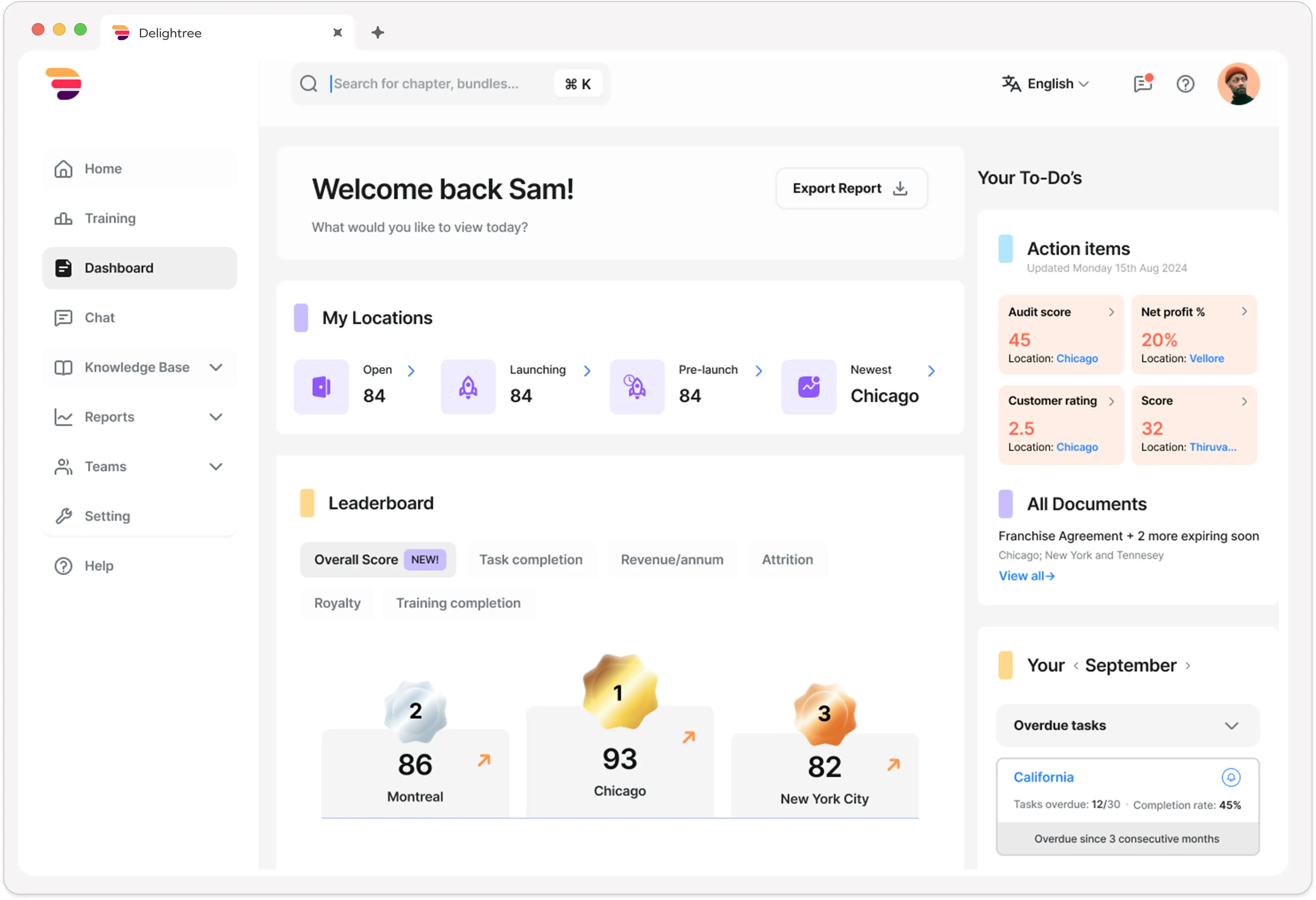
Delightree location dashboard

Product Overview

  1. Pain: The closing checklist was signed off but you still cannot prove it happened

    Paper checklists get filled in at the end of the shift from memory, and digital ones get tapped through without the work being done. When a health inspector or a franchise attorney asks what happened on a specific night at a specific location, a tick in a box is not sufficient evidence.

    Solution: Tasks belong to the location, and photos attach to the step

    Daily and closing checklists are assigned to the location and not a named person, so they survive a shift change, and photos as proof attach to the individual step instead of to the checklist as a whole. Headquarters gets proof of execution at every location. SubContain removed four hours a week of manual spreadsheet work by moving off spreadsheets entirely.
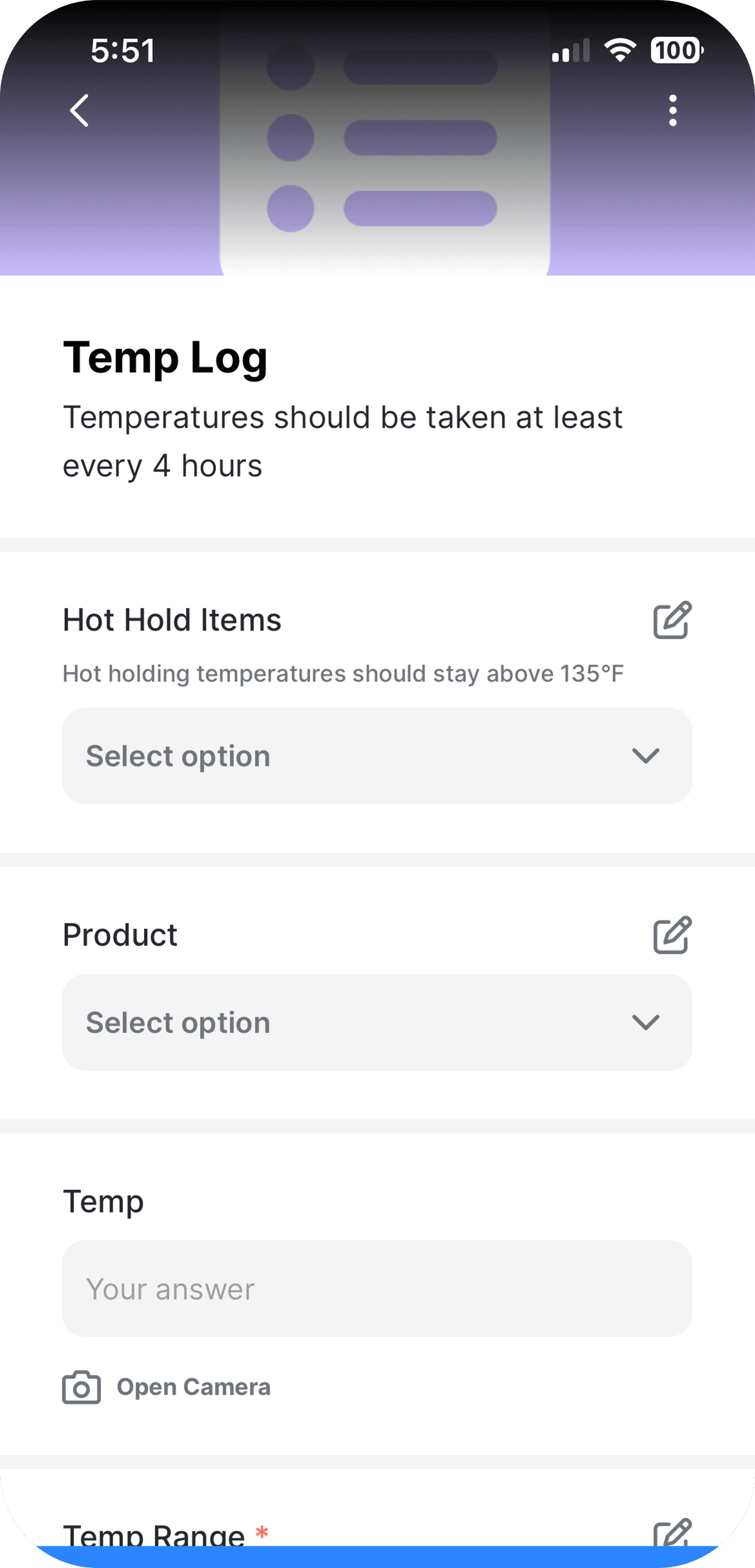
    Delightree closing checklist with proof photos
  2. Pain: The same food safety finding keeps coming back

    A field visit flags the walk-in temperature log. The finding gets written up, a task gets created somewhere, and next quarter the same item fails again because nobody closed the training gap that caused it in the first place. The audit program documents the problem without actually doing anything to make sure the process changes.

    Solution: The finding becomes a corrective task and retraining is assigned from the audit screen

    A failed audit item becomes a corrective action task with an owner and a deadline. From the audit screen, the franchisor can assign the relevant training module to that location’s team, raise a support ticket if the cause is equipment, and trigger a follow-up visit to check the fix. L&L Hawaiian Barbecue runs 170+ mainland audits every month through the mobile app.
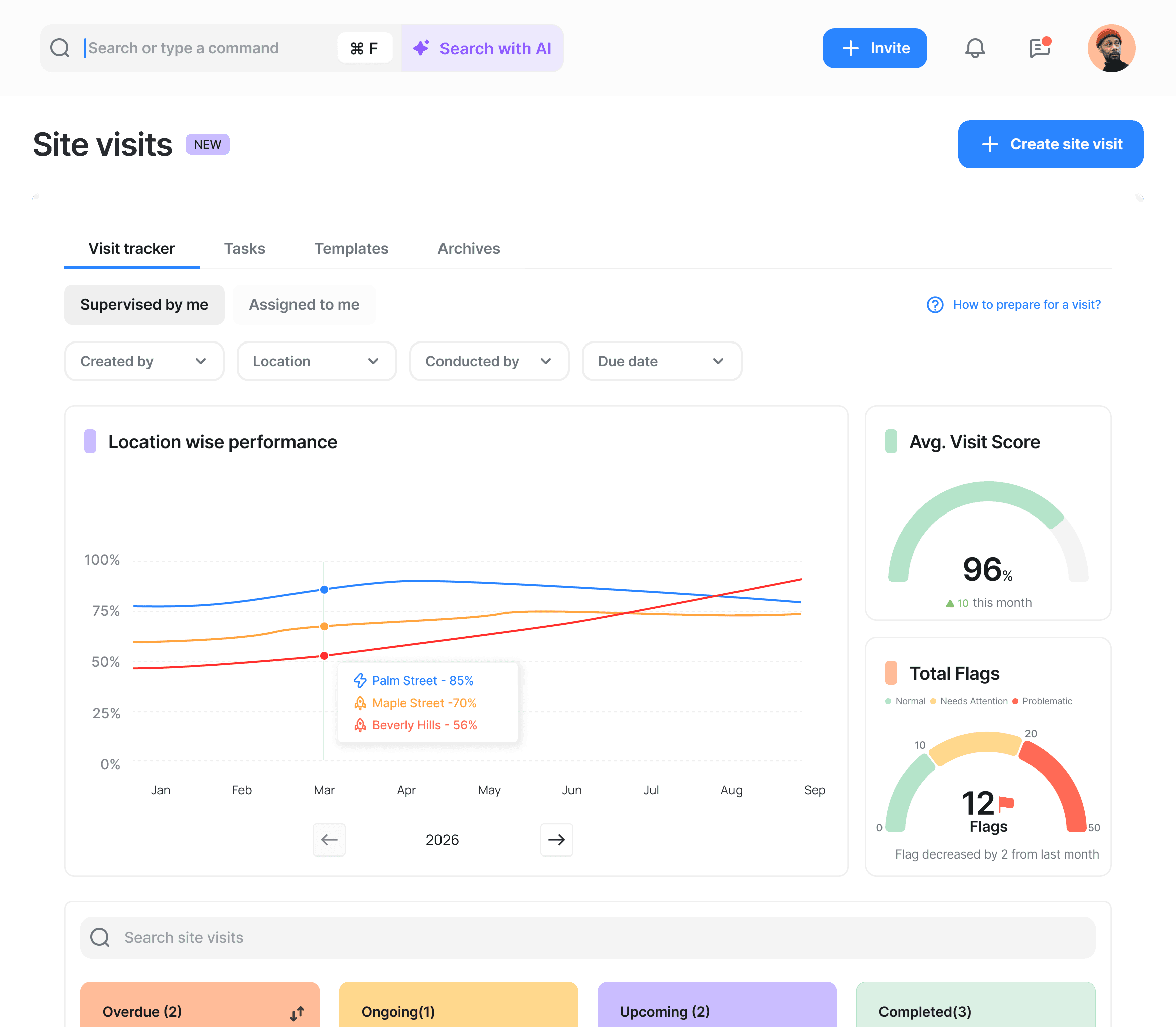
    An audit finding creating a corrective task in Delightree
  3. Pain: A restaurant opening gets pushed back and the status call finds out a week late

    Openings are tracked in a shared tab that is accurate on Monday but stale by Thursday. A delayed opening costs thousands of dollars a week in lost royalties, and a project tool ends at go-live while the restaurant still has to run service the next morning.

    Solution: A phased opening program that the restaurant keeps using after launch

    Location Launcher turns each opening into a phased playbook, with built-in training, SOPs and compliance gates. The next phase opens only when the opening team finishes the current one, and the restaurant then keeps using the same platform, on the same SOPs and the same training it opened with. Tony Roma’s replaced weekly spreadsheets and status calls with real-time launch visibility.
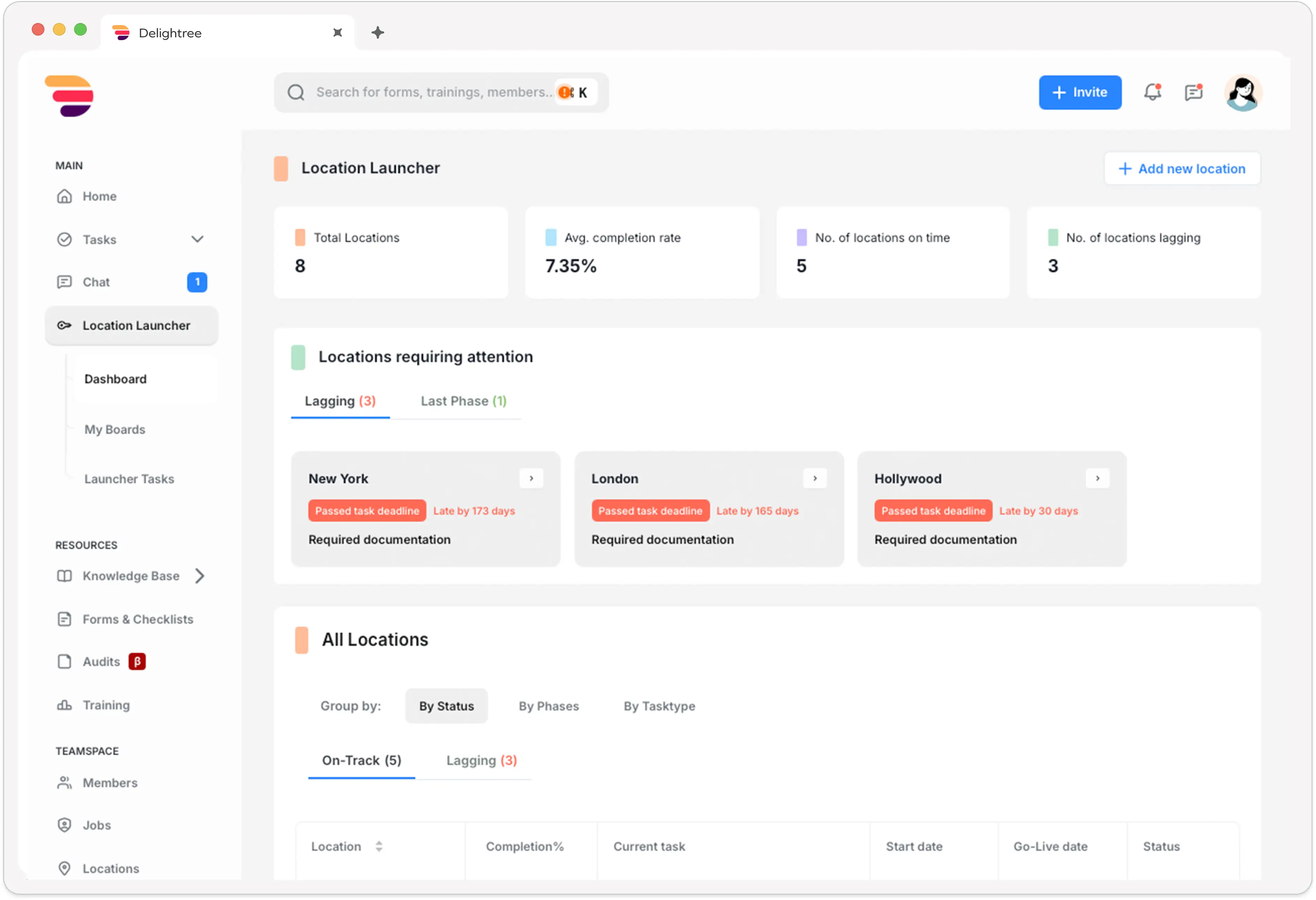
    Delightree Location Launcher phase gates

Interactive Product Demo

About 3 minutes, no form. Open the full tour

Pricing

Flat rate per location with unlimited users and full feature access. In a restaurant network, this matters more than in most categories, because turnover is high and crew counts are large, so a per-seat platform charges you again for every replacement hire. Pricing requires a custom quote, and the three things that determine it are the number of locations, the length of the agreement, and your growth plans.

Integrations

Delightree connects natively with Zapier, QuickBooks, HubSpot, and Zenoti for wellness and beauty POS, with Zapier covering systems that have no native connector. For a restaurant brand specifically, name your POS and payroll systems during evaluation and get written confirmation of how each will connect, because this is the layer where restaurant brands most often find a gap late in the process.

Setup

Most franchise rollouts are measured in months. A smaller network with an HQ team that stays responsive through onboarding can go live in weeks, but that is not typical. Existing SOPs, training content and location structure are brought into Delightree during onboarding by Delightree’s own customer success team. It is not added to your team’s workload.

Tradeoffs

Delightree is not a POS, a back office or a payroll system, and it does not try to be, so a restaurant brand runs it in conjunction with three or four other platforms.. There is no inventory, food cost or invoice capture, and no labor scheduling. On food safety, Delightree works through checklists, scored audits and corrective actions rather than sensor hardware, so if you want temperature readings captured automatically, Jolt and Crunchtime both add IoT sensors natively and are worth looking at. It does not run franchise sales or royalty management. Delightree has 4.6 stars on G2 and 4.3 on the App Store.

Mini Case Study

Slick City replaced five separate tools with one system and built a repeatable opening process as it scaled past 32 territories.

“Having documented daily checks that are completed and cleaning tasks that are documented has been a game changer. We can audit what’s been done or not been done, and from a risk standpoint, it’s been critical.”
Wade Powell, Chief Operating Officer, Slick City
Read the full case study

See how Delightree helps multi-location teams run their day-to-day operations. Try the workflow yourself without filling out a form, or book a demo tailored to how your brand operates.

Book a Demo
Ranked #2

Operandio

Best for Food Safety Depth

Layer: Operations executionRestaurant Ops Score: 7.8/10

Operandio is a Melbourne-based operations platform for frontline teams, founded in 2019, and it is the closest direct competitor to Delightree on this page. Alongside checklists and audits, it runs a knowledge base, a mobile-first LMS, and new location openings, and it goes deeper than Delightree on food safety specifically.

Product Overview

Digital checklists and daily task management, brand audits and inspections with corrective action routing, HACCP-compliant food safety with temperature monitoring and label printing, employee communications, a searchable knowledge base, a mobile-first LMS with quizzes, badges, pathways and certificates, an AI-powered course builder, physical assessments for verifying hands-on skills onsite, supplier management, and Location LaunchPad for new openings. In February 2026, it acquired FranchiseLab, adding franchise recruitment.

Pricing

Custom quotes across Business and Enterprise tiers, with a 14-day free trial. Reviewers describe it as competitively priced against the enterprise franchise suites. Pricing combines locations, users and modules, so the per-user element is the part to model at restaurant headcount.

Integrations

Adequate across the restaurant stack, with temperature sensor and label printer hardware in its own ecosystem. Thinner outside food service.

Setup

Weeks. Reviewers describe it as approachable for non-technical users, and the mobile-first design means frontline onboarding moves faster than a traditional franchise suite.

Tradeoffs

Operandio has 4.9 stars from 22 reviews on Capterra, which is a strong score on a thin base, so reference calls at your own size matter more than the number. It is a small company at roughly 15 employees, and reviewers note that feature requests can take a long time to ship. Reporting maturity is the most consistent critique. The analytics layer is less developed than the task and inspection layers it reports on. It is hospitality-native, so nonfood concepts run into restaurant assumptions, and because it also serves corporate chains, hotels and gyms, franchisor and franchisee structure gets configured rather than inherited. Its AI is limited to the course builder and does not search your brand knowledge, and there is no support ticket channel from franchisee up to franchisor HQ.

Read the detailed comparison
Ranked #3

Crunchtime Ops Execution

Best for Enterprise Chains

Layer: Operations executionRestaurant Ops Score: 7.3/10

Crunchtime Ops Execution is the platform that used to be called Zenput, acquired by Crunchtime in June 2022. It supports more than 150,000 locations across more than 100 countries, with brands including Chipotle, P.F. Chang’s, Gong cha and Tacala Companies, which runs over 300 Taco Bell locations. For enterprise restaurant networks that need above-location teams to push programs and check they were followed, it is the most widely deployed tool in this layer.

Product Overview

Rolling out operational programs at scale, recurring task assignment, line checks and food safety routines with temperature monitoring, location audits with scoring, and execution visibility by region. It works best inside the broader Crunchtime suite, alongside inventory and labor forecasting, which is also the point at which the commitment gets significant.

Pricing

Custom quotes only, on a model combining tiers with the number of forms you use. Third-party sources report a starting point around $40 per location per month, though the real number depends on locations, form count and requirements. The form count is worth modeling, because more locations means more forms, which means a higher tier.

Integrations

Deep across the restaurant stack, particularly within the Crunchtime suite, with strong POS coverage.

Setup

Months, with the longest sales cycle on this page. This is enterprise software sold through a demo and a procurement process.

Tradeoffs

Since the acquisition, reviewers have raised questions about roadmap direction, how requests are handled, and the pace of product updates. There is no location opening program, so new restaurants still get tracked by hand. It is built for corporate chains, so franchisor-to-franchisee permissioning gets configured rather than modeled natively. It is also substantially heavier than a network below roughly 20 locations needs.

Read the detailed comparison
Ranked #4

Jolt

Best for Labels and Temperature Hardware

Layer: Operations executionRestaurant Ops Score: 6.6/10

Jolt is an operations platform built around what it takes to run a single food service location. It is used by over 300,000 workers globally with more than 700 million tasks completed, and major QSR brands run it at scale. On food safety hardware specifically, it is the most capable tool in this guide.

Product Overview

Recurring checklists, opening and closing routines, digital food safety logs, date labeling, IoT temperature sensors with alerting, forms, employee scheduling and a time clock. The hardware is the real differentiator, because temperature readings are captured automatically so you don’t have to rely on someone remembering to take one. One reviewer reported inspection scores improving from 65% to 98.8% after implementing it.

Pricing

Around $89.99 per month per location, with label printers and IoT sensors charged separately. Larger accounts get custom quotes.

Integrations

Common POS and scheduling tools, plus its own label printer and sensor ecosystem.

Setup

Weeks. Most operators find the interface simple enough for hourly staff, though configuring templates across many locations takes a real initial investment of time.

Tradeoffs

Jolt has 4.4 stars from 116 reviews on G2 and 4.6 on Capterra. It is built for the unit and not the network, so there is no franchisor-to-franchisee hierarchy, no training system, no brand knowledge base and no location opening capability. Reviewers describe a dated interface and slow login times, and staff adoption comes up repeatedly. One Capterra reviewer wrote that after several months of trying to get their staff to adopt it, it was not going to happen. Some reviewers also report friction when canceling.

Ranked #5

Toast

Best Restaurant POS

Layer: POSRestaurant Ops Score: 6.4/10

Toast is the leading restaurant POS and the platform most brands reading this page will already run. It is included because it increasingly sells beyond the till, into payroll, scheduling and reporting, and operators reasonably ask how much of the operations layer it covers. The honest answer is some of it, and not the part that proves the standard ran.

Product Overview

Restaurant-grade POS hardware, handhelds and kiosks, order and payment management, online ordering and delivery integrations, menu management that syncs instantly across locations, per-location and aggregated reporting, plus payroll and scheduling modules. Offline mode is a genuine strength, letting service continue through a network outage.

Pricing

They offer a $0 Starter Kit, and there are three plans, but the real cost is the whole stack, which includes mandatory payment processing, proprietary hardware, and add-on modules. Processing rates are negotiable at volume.

Integrations

More than 80 third-party integrations, including the major delivery platforms, Restaurant365, 7shifts and most back-office tools. The strongest integration surface in this guide.

Setup

Days to weeks. Multiple reviewers confirm new staff learn the interface within a single shift, and 24/7 support is included on every plan, which is unusual in POS.

Tradeoffs

Toast has 4.2 stars from 371 reviews on G2 and 4.2 across 554 Capterra reviews, but 2.7 from 1,49 reviews on Trustpilot. G2 skews toward front-of-house staff rating the interface, while Trustpilot and the BBB skew toward owners raising contract and billing issues. You are also locked into proprietary hardware and mandatory processing with no third-party processor option, so switching later means abandoning the hardware. For this guide specifically, Toast has no brand standards audit program, no corrective action loop, no SOP knowledge base and no location opening program.

Ranked #6

FranConnect

Best for Restaurant Franchise Development

Layer: Franchise developmentRestaurant Ops Score: 6.3/10

FranConnect is a leader in franchise software, with 1,500+ brands and 1.3 million locations on the platform across franchise sales, royalty management, field operations and training through World Manager. For a restaurant franchisor, it is the only platform here that handles the development side, and it does ship compliance checklists and an opener module.

Product Overview

Franchise sales CRM with Item 23 receipt handling, franchisee onboarding, royalty calculation and collection, FDD and compliance document management, field visit and audit modules, an opener module for new restaurants, and embedded training. Nothing else in this guide covers that much of a franchisor back office.

Pricing

Custom quote, priced by module and system size, with no published list price and no free tier. Third-party estimates put enterprise plans between $1,000 and $2,000 per month depending on modules, users and locations.

Integrations

Broad and enterprise-grade with an API, across POS, accounting and marketing systems.

Setup

Months, usually requiring a dedicated project team. Implementation is the most commonly cited friction point.

Tradeoffs

Frontline adoption is the recurring complaint, and reviewers point at usability as the cause, describing software that is clunky and overly complicated and hard enough for frontline staff to use that they stop using it. FranConnect holds 4.3 from 209 reviews on Capterra, with ease of use at 4.2 and value for money at 4.2, both below its customer service score of 4.5. The audit loop also stops short. Findings can create a task, but retraining and verification sit in a separate module. World Manager is a FranConnect product, which is worth knowing if you are evaluating them as two options.

Read the detailed comparison
Ranked #7

SafetyCulture

Best for Inspection-Led Compliance

Layer: Operations executionRestaurant Ops Score: 6.0/10

SafetyCulture, formerly iAuditor, is the category leader in digital inspections, used well beyond restaurants across construction, manufacturing and retail. For a restaurant franchise, it is the strongest option if your program is inspection-led and you want to digitize audits quickly without rolling out a full operating system.

Product Overview

Mobile inspections with photo evidence and conditional logic, scored audits, corrective action assignment, offline capture, a large template library, sensors and analytics. Following the EdApp acquisition, it also carries a training product, which makes it broader than a pure inspection tool.

Pricing

Per user, which is the structural problem at restaurant scale, because the bill climbs with every crew member you put in the system. A free tier exists for small teams.

Integrations

Broad general-purpose integrations, plus an API. Thinner on restaurant-specific systems than Crunchtime or Toast.

Setup

Days to weeks. One of the faster deployments here, and the template library shortens setup considerably.

Tradeoffs

SafetyCulture holds 4.6 from 483 reviews on G2, which is a deep and credible review base, and the strongest peer validation of any execution tool on this page. It is a general-purpose compliance platform rather than a franchise or restaurant platform, so there is no franchisor-to-franchisee hierarchy and franchise permissioning has to be rebuilt by hand. There is no location opening program and no SOP knowledge base with search. The training layer arrived by acquisition and not as part of the operating loop, and per-user pricing works directly against the broad frontline access that adoption depends on.

Read the detailed comparison
Ranked #8

Restaurant365

Best for Multi-Entity Accounting

Layer: Back officeRestaurant Ops Score: 5.5/10

Restaurant365 is the strongest back office platform in restaurants and the only one here that handles multi-entity accounting and royalty billing natively, which matters to a franchisor collecting from franchisees. Clients include Portillo’s, Walk-On’s and Newk’s Eatery. If your gap is financial and notoperational, this is the answer and Delightree is not.

Product Overview

Restaurant-specific accounting, accounts payable and receivable, inventory and food cost management, recipe costing, labor scheduling, payroll, and consolidated multi-location reporting. Optional modules cover Catering, Franchising, Commissary, Advanced Budgeting and Fixed Assets.

Pricing

Custom pricing based on number of locations, with modules charged separately. No published list price.

Integrations

Deep and genuinely two-way: Toast, PAR Brink, QuickBooks Online, Workday and most major POS and payroll systems. Daily sales and labor flow in automatically.

Setup

Months. This is a finance system implementation with a chart of accounts behind it, not a rollout.

Tradeoffs

Restaurant365 has 4.6 from 324 reviews on G2 with 74% of reviewers at mid-market scale, which is a strong and credible base. Reviewers note the Commissary function has limitations for brands with significant wholesale operations. For this guide, the point is scope rather than quality. There are no brand standards audits, no corrective actions, no SOP knowledge base, no training and no location opening program.

Ranked #9

7shifts

Best for Scheduling and Labor

Layer: WorkforceRestaurant Ops Score: 5.4/10

7shifts is the most widely adopted workforce management platform in restaurants, built exclusively for the industry. Clients include Bareburger, Modern Market and Sauce Pizza & Wine. It appears in franchise evaluations because scheduling touches every location daily and because its task management module edges into the execution layer.

Product Overview

Employee scheduling with templates and auto-scheduling, time and attendance, labor budgeting and sales forecasting, tip pooling, team chat and announcements with read receipts, a manager logbook, and a task management module on the top tier.

Pricing

Four tiers priced per location per month. The Comp tier is free for one location, and paid plans start at $34.99 and rise through Entrée, The Works and Gourmet. Task management and operational planning only appear on the top Gourmet tier, and tip pooling is a $24.99 per location per month add-on.

Integrations

More than 70 integrations including Toast, Square, NCR Aloha, Revel, Lightspeed, Gusto and ADP Workforce Now. Strong POS coverage.

Setup

Days. The free tier means you can trial it properly before committing.

Tradeoffs

7shifts has 4.5 from 129 reviews on G2, with 56% of reviewers at small-business scale, so it skews smaller than a 300-location franchisor. Reviewers report price increases alongside support that has declined from prior years, plus occasional app bugs and notification delays. For this guide, the limits are scope. The task module sits behind the top tier, and there is no scored brand audit program, no corrective action loop, no SOP knowledge base and no location opening program. It manages the schedule, not the standard.

Ranked #10

Square for Restaurants

Best for Emerging Restaurant Franchises

Layer: POSRestaurant Ops Score: 5.1/10

Square for Restaurants is the accessible POS option, with transparent published pricing and a genuinely usable free tier. For an emerging restaurant franchise under roughly 20 locations that wants predictable costs and fast setup, it is a reasonable alternative to Toast, and franchisees often already know it.

Product Overview

POS with order and payment management, menu management, basic multi-location reporting, online ordering, and integrations across the Square ecosystem including payroll and marketing. Setup is self-serve in a way most restaurant POS platforms are not. A MarketMan inventory add-on arrived in April 2026.

Pricing

Published tiers including a free plan, which is unusual in this category and a real advantage at the research stage. Payment processing is bundled at flat-rate fees of roughly 2.4% to 2.6% plus 15 cents, which gets expensive for high-volume or large-ticket restaurants.

Integrations

More than 20 third-party tools including QuickBooks Online, 7shifts, BentoBox, Chowly, Deliverect and MarketMan, plus the wider Square ecosystem.

Setup

Days, largely self-serve.

Tradeoffs

Square for Restaurants has 54 verified Capterra reviews, a much thinner base than Toast, though the wider Square Point of Sale product sits around 4.6 from 3000+ reviews. Reviewers say drill-down reporting stops at the category level, and they report random glitches that crash the iPads, as well as printer disconnects and lost tickets when the internet drops. Free-plan phone support is limited to the first 90 days. Centralized control across many locations is weaker than Toast, which matters as a brand scales. For this guide, the same layer point applies as with Toast. There is no brand standards audit, no corrective actions, no SOP knowledge base, no training and no location openings.

Ranked #11

Workstream

Best for Hourly Hiring and Onboarding

Layer: WorkforceRestaurant Ops Score: 4.8/10

Workstream is a hiring and onboarding platform built for hourly, high-turnover workforces, which describes almost every restaurant franchise. It is in this guide because onboarding paperwork is the first thing a new crew member touches and because brands frequently confuse hiring onboarding with operational training.

Product Overview

Text-based applicant sourcing and screening, automated interview scheduling, digital offer letters, I-9 and W-4 completion, and new hire paperwork workflows. It reduces time-to-hire meaningfully in a category where a vacancy costs a shift.

Pricing

Custom quote, typically per location. No published list price.

Integrations

Integrates with major POS systems including Toast, Square, PAR and Clover, plus payroll providers.

Setup

Days to weeks.

Tradeoffs

The scope boundary is the important thing here, and it is frequently misunderstood during evaluations. Workstream onboards a person into employment. It does not train them on the brand standard, does not check whether they follow it, and does not connect a failed standard to retraining. There is no SOP knowledge base, no scored audits, no corrective actions and no location opening program. Budget for it alongside an operations platform. Independent review data is thin enough that reference calls matter more than the published score.

Ranked #12

MarketMan

Best for Inventory and Food Cost

Layer: Back officeRestaurant Ops Score: 4.4/10

MarketMan is an inventory, purchasing and food cost platform for restaurants, and one of the few tools in this guide with published pricing. It is the narrowest entry here by design, and it is included because food cost is often the problem an operator names when the real problem is execution.

Product Overview

Inventory counts, supplier ordering and invoice capture, recipe costing, variance tracking and food cost reporting. It does the job well and connects cleanly to the POS and accounting layers around it.

Pricing

Published tiers, which makes it one of the easier platforms here to budget for.

Integrations

Connects to major POS systems and accounting platforms including Restaurant365, QuickBooks and Square, where it now also ships as an inventory add-on.

Setup

Weeks, mostly spent building the item and recipe database.

Tradeoffs

MarketMan has 4.7 stars from 112 reviews on Capterra, a solid score on a reasonable base, and reviewers consistently praise the onboarding support while noting a learning curve during setup and limited custom report building. It is a single-purpose back office tool and makes no claim otherwise. There is no operations execution layer at all: no checklists, no audits, no corrective actions, no training, no SOP knowledge base, no location openings, and no franchise hierarchy. A brand whose variance is high because the standard is not being followed will not fix that with better variance reporting.

How We Built This Guide

Restaurant franchise operators shopping this category are usually trying to answer one question and are buying from the wrong layer to answer it. They can see sales, cost and labor. They cannot see whether the closing checklist got done or what happened after the last brand audit found a problem.

We assessed 12 platforms during August 2026 against six weighted criteria, using product documentation, published pricing, verified review data on G2 and Capterra, product tours where available, and the questions restaurant franchisors ask during real evaluations. Where a vendor does not publish pricing, we say so instead of estimating. Where a review base is thin or skewed, we flag it, because 4.9 from 22 reviews and 4.7 from 454 are not the same signal, and a G2 score built from front-of-house staff provides different insight than a Trustpilot score built from owners.

This guide is for Vice Presidents and Directors of Operations, Chief Operating Officers and founders at restaurant and QSR franchise brands running roughly 10 to 300 locations, plus large multi-unit franchisees running a meaningful share of a network. It is not written for people researching which franchise to buy into.

How to Choose Restaurant Franchise Software

  1. Step 1: Work out which of the five layers is actually failing

    Write down whether the problem is POS, back office, workforce, franchise development, or operations execution. Most brands own three already and are shopping for a fourth without naming it. Buying a better POS when the problem is execution is the a common and expensive mistake in this category.

  2. Step 2: List what you already pay for before adding anything

    Write out every subscription across all five layers with its annual cost and renewal date. Brands routinely find they are paying for a checklist module inside the POS and another inside the scheduling tool, both unused, while shopping for a third.

  3. Step 3: Model per-location cost against per-user cost at restaurant turnover

    Take your real annual turnover and crew count per location, then build the three-year bill both ways. At restaurant churn rates, per-seat pricing charges you repeatedly for the same seat, and the usual response is to cut access, which is the same as cutting adoption.

  4. Step 4: Decide whether you need logged temperatures or automatic ones

    This is the sharpest split in the food safety layer. Checklist-based platforms record a reading that a person took. Jolt, Crunchtime and Operandio all offer sensor hardware that records continuously and alerts when something goes out of range. One is a temperature record and the other is a temperature intention, and only you can say which your inspector expects.

  5. Step 5: Follow one food safety finding from detection to verified fix

    Take a real failed item from your last field visit and walk it through every demo. Finding, corrective task, retraining, re-check, closed. Count the systems and the manual handoffs. Most platforms stop at task creation.

  6. Step 6: Test the mobile experience on a line during service

    Have a shift lead complete a checklist during a rush, on the actual device, on the actual connection. Load times and tap counts decide whether the record is real or invented in a rush at the end of the night.

  7. Step 7: Check that every location sees the current version of the SOP

    Ask how a restaurant is prevented from working off v1 when HQ has published v2, and whether the training attached to that SOP updates with it. Version drift is where consistency breaks down, and it rarely comes up in a demo unless you raise it.

  8. Step 8: Ask what happens to a new restaurant the morning after it opens

    Delightree, Operandio and FranConnect all cover openings in some form, and most of the rest of this page does not. The useful question is not whether openings are tracked, but whether the restaurant keeps running on the same SOPs, training and checklists it launched with.

  9. Step 9: Confirm POS, accounting, HRIS and payroll integrations in writing

    Name your actual systems and get confirmation of how each connects. Without the roster and location hierarchy flowing in, the platform becomes another silo and someone at HQ maintains it by hand.

  10. Step 10: Check audit throughput and offline behavior

    If your field team runs 100+ visits a month, ask what happens when the app loses signal in a walk-in or a basement office. Offline capture with reliable photo sync makes an audit program invaluable.

  11. Step 11: Scope migration and ask who rebuilds your checklists

    You have years of checklists, templates and audit forms. Get a written scope: what imports, what has to be rebuilt, who does it, how long you run two systems, and what it costs.

  12. Step 12: Plan the franchisee conversation and check your FDD

    A skeptical franchisee advisory council can stall a deal operations has already decided on, and a technology fee that is not in your FDD can become a legal question. Ask each vendor how other brands introduced the fee and built council support before rollout.

Restaurant Franchise Software Pricing Models Compared

Four models appear on this page, and at restaurant headcount, the difference between them compounds quickly.

Per user. SafetyCulture and the user portion of Operandio’s pricing are per user. A 50-location brand with 25 crew per location is 1,250 seats, and restaurant turnover means you buy many of those seats more than once a year. This is the model that can cap adoption.

Per location, published. 7shifts is the clearest example, free for one location and then $34.99 and up per location per month across four tiers, with task management only on the top tier. Jolt is around $89.99 per location plus hardware, and Square publishes its tiers too. Published per-location pricing is the easiest to budget and the easiest to compare.

Per location, quote only. Delightree and Operandio both price this way without publishing a figure. Delightree includes unlimited users and every HQ seat, which is the strongest version of this model at restaurant turnover. Crunchtime also prices per location but adds a form count on top, so the bill rises with locations and forms together.

Per module or linked to processing. FranConnect and Restaurant365 price by module. Toast bundles a low or zero software price with mandatory payment processing, so the real cost sits in the processing rate rather than the subscription line. Square does the same at 2.4% to 2.6% plus 15 cents. Compare the total price, and not just the headline cost.

Questions worth asking about cost

  • Is this per location, per user, per module, or linked to processing volume?
  • What happens to the bill when we add restaurants midterm, or when one closes?
  • Which capabilities sit behind a higher tier, and is task management one of them?
  • What does the hardware cost per location, and who owns it if we leave?
  • What are implementation and migration fees, and who rebuilds our checklists?
  • How long do we run two systems during migration?
  • What is the contract term, is there an out clause, and what is the early termination fee?
  • Our technology fee is not in our FDD yet. How do other brands handle that?
  • Can we pilot in a few restaurants before signing?

Key Features to Look For in Restaurant Franchise Software

  1. A versioned SOP and recipe knowledge base

    Recipes and procedures change constantly, and a location working from last quarter’s spec is a consistency problem and a food cost problem at the same time. Look for one versioned source that both the training and the audit criteria are built from.

  2. Role-based training for high-turnover hourly teams

    A training assignment tied to a named person dies when that person leaves, which in a restaurant happens constantly. Assigning by role and location survives the churn and keeps the record continuous.

  3. Daily and closing checklists owned by the location

    When a task belongs to a person who is off shift, the task does not get done. Tasks owned by the location, completed by whoever is working, produce a record that reflects what actually happened.

  4. Food safety workflows, and a decision about sensors

    Decide whether you need logged readings or automatic capture. Sensors remove the human step entirely, which is the difference between a temperature record and a temperature intention, and the platforms split cleanly on this.

  5. Scored brand audits and site visits on mobile

    Field managers do not carry laptops into a restaurant. If the audit is not fast on a phone and reliable offline, it gets completed from memory in the car and the scores stop meaning anything.

  6. Corrective actions that lead to retraining and re-verification

    The gap between a finding and a fix is where repeat findings live. Look for a route from a failed item to a corrective task to the training that closes the gap, without exporting anything.

  7. Proof photos attached to the step

    A photo attached to the checklist proves something happened somewhere. A photo attached to the individual step proves that step happened, which is what an inspector or an auditor actually asks for.

  8. A phased opening program that continues after launch

    Openings tracked on a spreadsheet are far from efficient. Look for a program that opens the next phase only when the current one is finished, and that keeps running the restaurant afterwards rather than handing it off.

  9. Communications with read and acknowledgment tracking

    Menu changes, limited time offer launches and recall notices all depend on someone having seen them. Acknowledgment tracking turns a dispute with a franchisee into a simple matter of looking up who opened up the documents.

  10. Offline capture with reliable photo sync

    Walk-ins, basements and rural locations all break connectivity, and photos are the heaviest thing to sync. Test what happens to a half-finished audit when the signal drops, because the answer decides whether your field program is real.

  11. AI search over approved operating content

    A shift lead with a question either finds the answer or calls the area manager. Search that answers from your own approved SOPs and returns the source document is what makes it trustworthy in the middle of service.

150+ franchise brands

See how Delightree runs a multi-unit network

See how Delightree helps multi-location teams run their day-to-day operations. Try the workflow yourself without filling out a form, or book a demo tailored to how your brand operates.

“Having documented daily checks that are completed and cleaning tasks that are documented has been a game changer. We can audit what’s been done or not been done, and from a risk standpoint, it’s been critical.”
Wade Powell, Chief Operating Officer, Slick City

Frequently Asked Questions

What is restaurant franchise software and how does it work?

It is not one category. Restaurant franchise software spans five layers: POS for the transaction, back office for accounting and food cost, workforce for hiring and scheduling, franchise development for royalties and FDD, and operations execution for SOPs, checklists, audits and training. Most brands run three or four of these and shop for the one that is failing.

What is the difference between restaurant franchise software and a restaurant POS?

A POS runs and records the transaction. Restaurant franchise software in the operations sense records whether the brand standard ran, including whether the closing checklist was completed, whether the temperature was logged, and what happened after an audit finding. Toast reports what you sold. It does not tell you whether the walk-in was checked.

Do you need restaurant franchise software if you already run Toast and Restaurant365?

Usually yes, because those two cover the POS and back office layers and neither covers operations execution. Toast reports sales, Restaurant365 reports cost, and neither answers whether the standard ran last night at every location. If you can already answer that reliably, you do not need another tool.

Which restaurant platforms capture temperatures automatically rather than by hand?

Jolt, Crunchtime Ops Execution and Operandio all offer sensor hardware that records continuously and alerts when a reading goes out of range. Delightree handles food safety through checklists, scored audits and corrective actions rather than sensor hardware, so brands that want automatic capture typically run one of the three alongside it or pick one of them for that layer.

Can digital checklist and audit records be used for health inspections and third-party audits?

Yes, and that is much of the point, but the quality of the record decides it. Timestamped completion, proof photos attached to the individual step, named accountability and a tracked corrective action stand up. A tick in a box completed from memory after service does not.

What happens if a restaurant loses internet mid-shift?

Ask every vendor this directly and then test it. The strong platforms capture offline and sync when the connection returns, which matters in walk-ins, basement offices and rural locations. If a half-finished audit is lost when the signal drops, your field team will stop running audits on the app.

How do you get shift leads to complete checklists during a rush?

It comes down to delivery mechanics. Think short checklists on a phone, tasks owned by the location rather than an absent person, and a login with no friction. Then measure use Ask whether the platform can name the locations that have not opened the app this week rather than showing you a network average.

How do multi-brand restaurant groups handle different standards per concept?

Look for brand as a first-class object in the hierarchy, so corporate can publish one standard to one concept without it reaching another. Delightree models franchisor, franchisee, manager and frontline with brand scoping, while general multi-site tools require you to rebuild that separation by hand.

Does restaurant franchise software help open new restaurants, or only run existing ones?

Three platforms here cover openings. Delightree has a phased Location Launcher where the next phase unlocks on completion, Operandio has Location LaunchPad, and FranConnect has an opener module. Crunchtime, Jolt and SafetyCulture have no location opening tooling at all, and neither do the POS, back office or workforce platforms.

Do you still need a checklist app like Operandio or Jolt if you run a full operations platform?

Generally not, and consolidation is usually the point, because franchisees will not log into four systems. The exception is hardware. If you rely on Jolt’s date labeling or its IoT temperature sensors, that hardware ecosystem is a real reason to keep it alongside a broader platform.

More Franchise Operations Resources

The product names, logos, and brands referenced on this page are the property of their respective owners. Delightree is not affiliated with, endorsed by, or sponsored by any other company named here. This page reflects Delightree's opinions and is based on publicly available information believed to be accurate as of August 2026. Competitor pricing and features change frequently; confirm current details on each provider's official website before making a purchasing decision.