
Skip to content
Best-Of GuideUpdated

9 Best Franchise Training Software and LMS Platforms in 2026

We looked at 9 franchise training platforms and scored them on how an hourly worker gets in and finishes tasks, whether the platform can show competence and not just completion, whether it understands franchisor and franchisee structure and permissioning, and what the bill does at franchise turnover. Delightree is the best overall choice for brands that need training connected to daily operations. Opus Training is the strongest choice for multilingual frontline teams, and Operandio is for brands that need training alongside food safety.

  1. Best Overall

    Delightree

  2. Best for Multilingual Frontline Teams

    Opus Training

  3. Best for Training Alongside Food Safety

    Operandio

Joseph Ortega

Written by Joseph Ortega, Digital Growth Marketing Lead at Delightree

Before Delightree, he worked in franchise marketing at CorePower Yoga, Sola Salon Studios, and Fortidia's PostNet and AlphaGraphics brands, where he worked closely with operations teams to support large franchisee networks and keep every location on brand.

LinkedInPublished Updated

It’s not hard to prove somebody watched a video.

The problem shows up the week after a failed audit, when a franchise attorney or a health inspector asks what training a location actually had, and the only answer you have is a completion percentage. Completion tells you a module was opened. It does not tell you whether the closing procedure was done properly on a Friday night, or which people ignored the update you published in March.

Then, there’s a second problem. The learner is an hourly employee who often has no company email address, works in a role with high turnover, and has no reason to finish anything on a laptop. How the training is delivered determines whether it gets done, even more than the quality of the content. Most franchise training software is chosen by a learning and development team looking at a desktop, but the actual program is then used, or not used, by a 19-year-old on a phone during a shift change.

This guide compares the 9 platforms franchise brands actually shortlist for training. Note that one distinction is worth settling first. Documentation tools, learning platforms, and operational verification are three different products. Trainual documents a process. Docebo delivers a course. Neither of them tells you that a standard was followed. Knowing which of the three products you are buying is the difference between a tool your franchisees use and another login they ignore.

Best Franchise Training Software in 2026: Comparison and Ratings Chart

  1. #1 Delightree

    Best Overall

    9.0/10

    Best For
    Best Overall
    Frontline Login
    Mobile app, role-scoped
    Languages
    Limited
    Franchise Tiers
    Four tier, native
    Pricing
    Per location, unlimited users
  2. #2 Opus Training

    Best for Multilingual Frontline Teams

    8.0/10

    Best For
    Multilingual frontline
    Frontline Login
    QR code, no email needed
    Languages
    130+
    Franchise Tiers
    Permissioned
    Pricing
    Per location, custom quote
  3. #3 Operandio

    Best for Training Alongside Food Safety

    7.9/10

    Best For
    Training alongside food safety
    Frontline Login
    Mobile-first
    Languages
    Multiple
    Franchise Tiers
    Partial
    Pricing
    Custom quote, 14-day trial
  4. #4 World Manager

    Best Franchise-Native LMS Inside a Suite

    7.0/10

    Best For
    Franchise-native LMS in a suite
    Frontline Login
    Mobile
    Languages
    Multiple
    Franchise Tiers
    Franchise native
    Pricing
    Per module, custom quote
  5. #5 Wisetail

    Best for Branded Learning

    6.3/10

    Best For
    Branded learning
    Frontline Login
    Mobile, lags desktop
    Languages
    AI translation
    Franchise Tiers
    Partial
    Pricing
    Custom, about $1,000+/mo
  6. #6 Connecteam

    Best for Training Bundled With Comms

    6.0/10

    Best For
    Training bundled with comms
    Frontline Login
    Mobile, no email needed
    Languages
    Limited
    Franchise Tiers
    None
    Pricing
    Free, then from $29/mo
  7. #7 LearningZen

    Best for Emerging Franchise Brands

    5.6/10

    Best For
    Emerging franchise brands
    Frontline Login
    Web and mobile, clunky
    Languages
    None
    Franchise Tiers
    Partial, training only
    Pricing
    Location tiers, not published
  8. #8 Docebo

    Best for Multi-Audience Enterprise

    5.5/10

    Best For
    Multi-audience enterprise
    Frontline Login
    Web-led, SSO
    Languages
    Extensive
    Franchise Tiers
    None
    Pricing
    Custom, enterprise
  9. #9 Trainual

    Best for SOP Documentation

    5.3/10

    Best For
    SOP documentation
    Frontline Login
    Web-led
    Languages
    Premium tier
    Franchise Tiers
    None
    Pricing
    Not published, see entry

Data current as of August 2026.

How We Evaluated These Franchise Training Platforms

We looked at 9 platforms during August 2026, using published pricing, product documentation, verified review data on G2 and Capterra, product tours where they were available, and the questions franchise training buyers ask during real evaluations.

The weightings reflect what decides whether franchise training works, which is not the same as what decides whether corporate training works. Frontline access carries the most weight because a course nobody can log into has no completion rate at all. Pricing carries the least in absolute terms, but the model matters more here than in most categories, because franchise workforces turn over several times a year and per-seat pricing charges you again every time.

Our Scoring Methodology

  1. Frontline Access and Completion25%

    How an hourly employee with no company email gets in and finishes. Mobile experience, how easy it is to log in, lesson length, offline behavior, and language coverage.

  2. Competence Verification20%

    Whether the platform can show the job is done properly rather than that a course was finished. Skill checks, manager sign-off, photo evidence, and certification tracking with expiry.

  3. Franchise Structure and Permissions15%

    Whether franchisor, franchisee, manager and frontline are modeled as standard, with corporate able to lock brand standards while franchisees add local content.

  4. Connection to Operational Execution15%

    Whether a failed standard leads back to targeted retraining, and whether training data sits alongside audit and task data.

  5. Content Operations and Version Control15%

    Who writes the content, how quickly it updates, and whether the course and the SOP it came from stay in step.

  6. Pricing Model at Frontline Turnover10%

    What the bill does as headcount churns and locations are added. Per user against per location against per module.

Scores on this page are measured against training specifically, so they differ from the scores in our Best Franchise Management Software guide, which uses a broader operations rubric. A platform can reasonably rank higher on one than the other.

The 9 Best Franchise Training Software Platforms in 2026

Our Top Pick
Ranked #1

Delightree

Best Overall

Franchise Training Score: 9.0/10

Delightree is the franchise operations platform behind 150+ franchise brands, including Tony Roma’s, L&L Hawaiian Barbecue, Clean Eatz, Sandbox VR and Slick City. Training is one module inside a larger franchise operating system rather than the whole product, and that is the reason it leads this guide. The training a location receives is built from the same versioned standard operating procedure that the location is audited against.

Best for: franchise brands of roughly 10 to 300 locations that need training records to hold up after an audit, and need retraining to actually follow a finding.
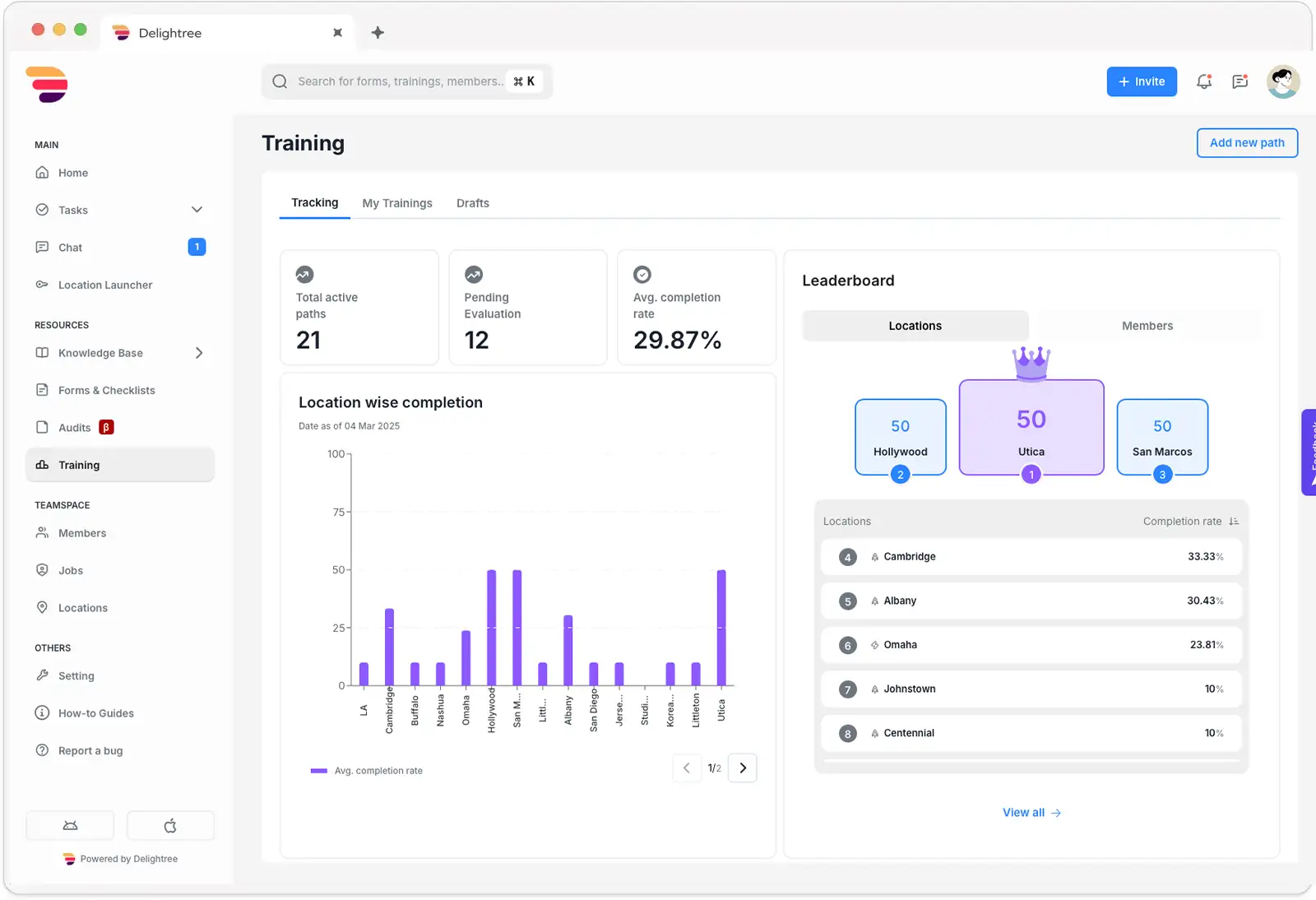
Delightree training module

Product Overview

  1. Pain: You can prove a course was completed, but not that the job is done properly

    A completion percentage is the thing you produce after something has already gone wrong, and it is weak evidence for a regulator, a franchise attorney, or a franchisee arguing about who was at fault. Training looks finished on paper but behavior on the floor does not change, and the same audit finding comes back the following quarter.

    Solution: Training is assigned by role, brand and location, and completion is tracked automatically

    Delightree assigns training by role, brand and location hierarchy, so a new hire gets the right training without anyone assigning it by name, and headquarters can see who is ready and who is not. Sandbox VR runs 85 to 90% training completion on it. Because completion sits in the same database as audit scores, task completion and location opening timelines, a franchisor can see whether the locations with low training completion are also the ones with falling audit scores. That connection is invisible when the data lives within separate platforms.
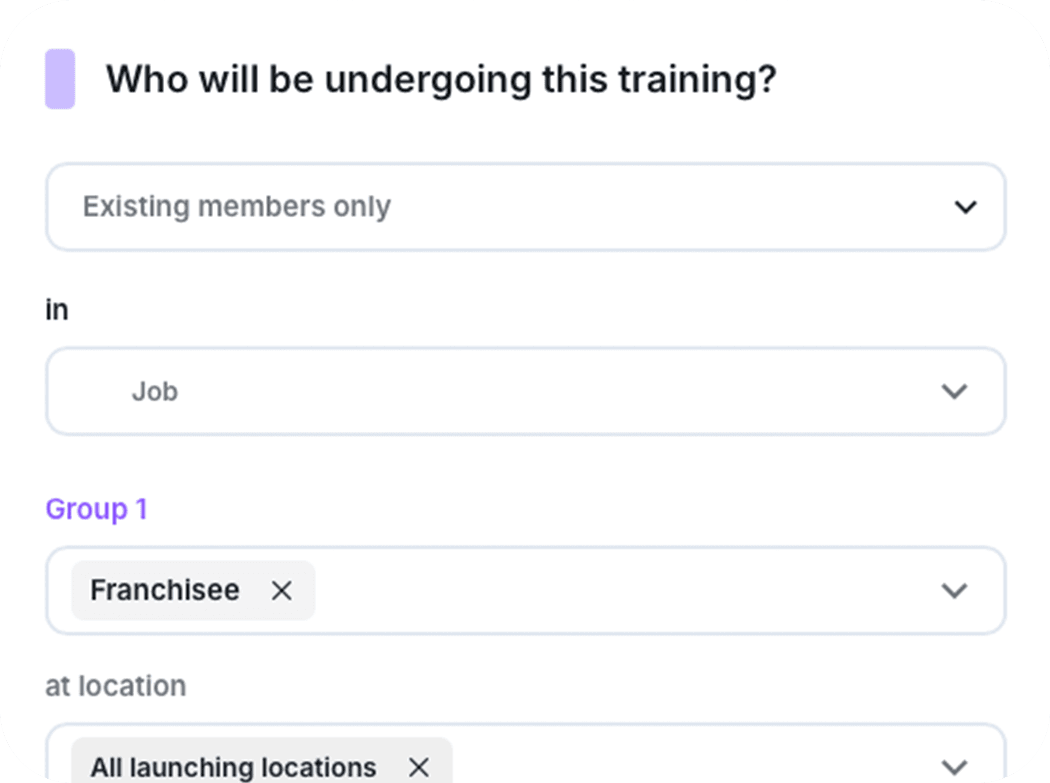
    Delightree training assigned by role and location
  2. Pain: An audit finds a gap and there is no direct route to retraining

    In most setups, the finding sits in an audit app and the course sits in a learning management system. Somebody has to spot the pattern, work out which module applies, assign it to the right people, and then follow up. Usually nobody does, so the training gap that caused the finding is never closed.

    Solution: The relevant training can be assigned from the audit screen

    When an audit turns up a gap at a location, the franchisor can assign the relevant training module to that location’s team directly from the audit screen, without copying findings into a separate LMS or tracking retraining in a spreadsheet. The failed item becomes a corrective action task, with an owner and a deadline, and a follow-up visit can be triggered to check the fix.
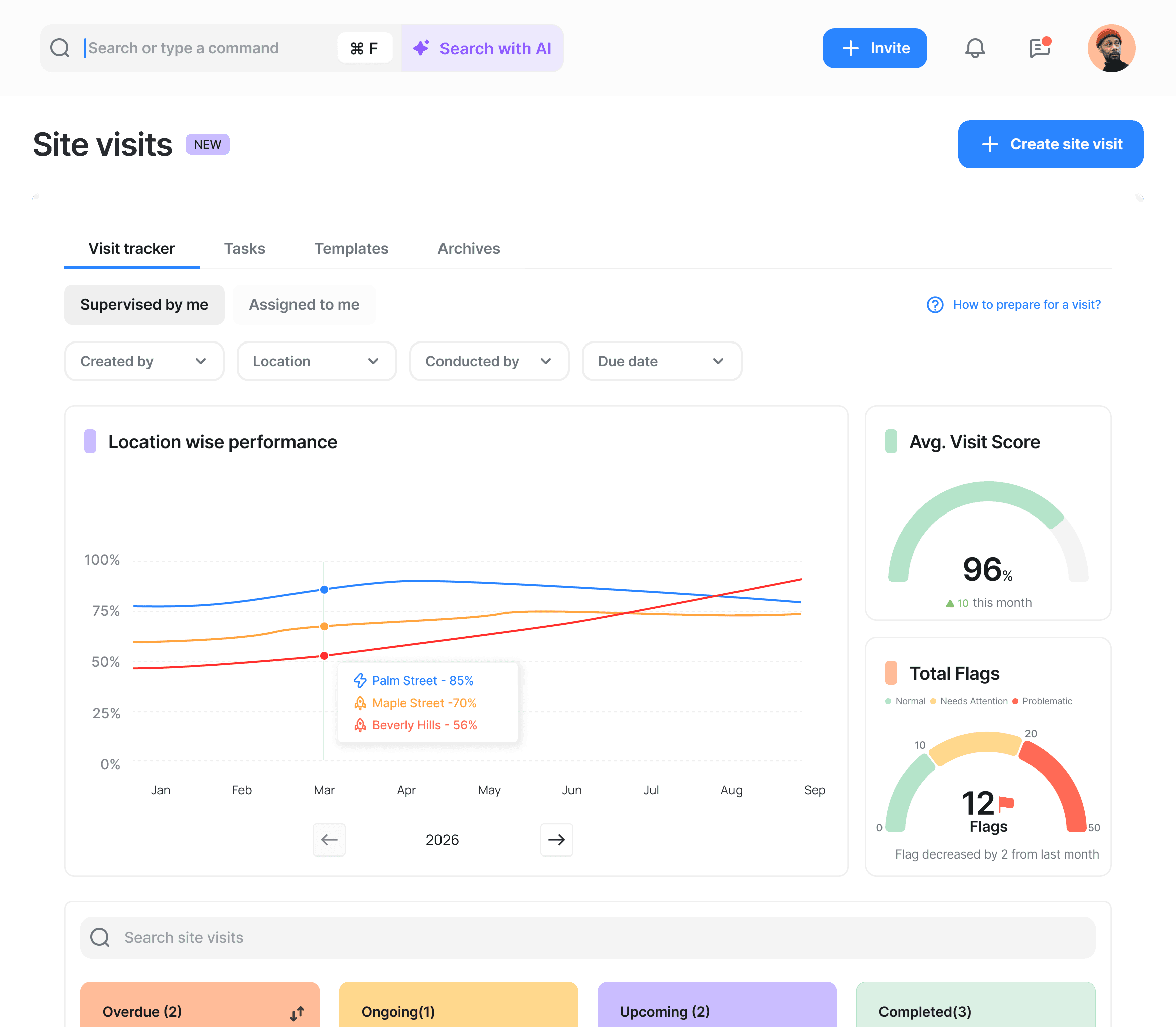
    An audit finding creating a corrective task in Delightree
  3. Pain: The course and the SOP drift apart

    HQ updates a procedure. The course that was built from that procedure does not update, so a v2 standard and a v1 course sit side by side, and the location gets trained on something that is no longer true. This is the quiet failure that makes training records basically useless during an investigation.

    Solution: Courses are built from the versioned knowledge base

    Every SOP, policy and brand standard lives in one Knowledge Base, and an update propagates across Training, Tasks and Audits rather than leaving stale copies in separate files. Content is authored with a no-code builder, so brand admins publish without a developer, and training is built for frontline workers with microlearning and vertical video. AI Search answers a franchisee’s question from that approved content and returns the source document, scoped to the person’s role and location. Beem stopped receiving its "I can’t find it" support emails after turning it on.
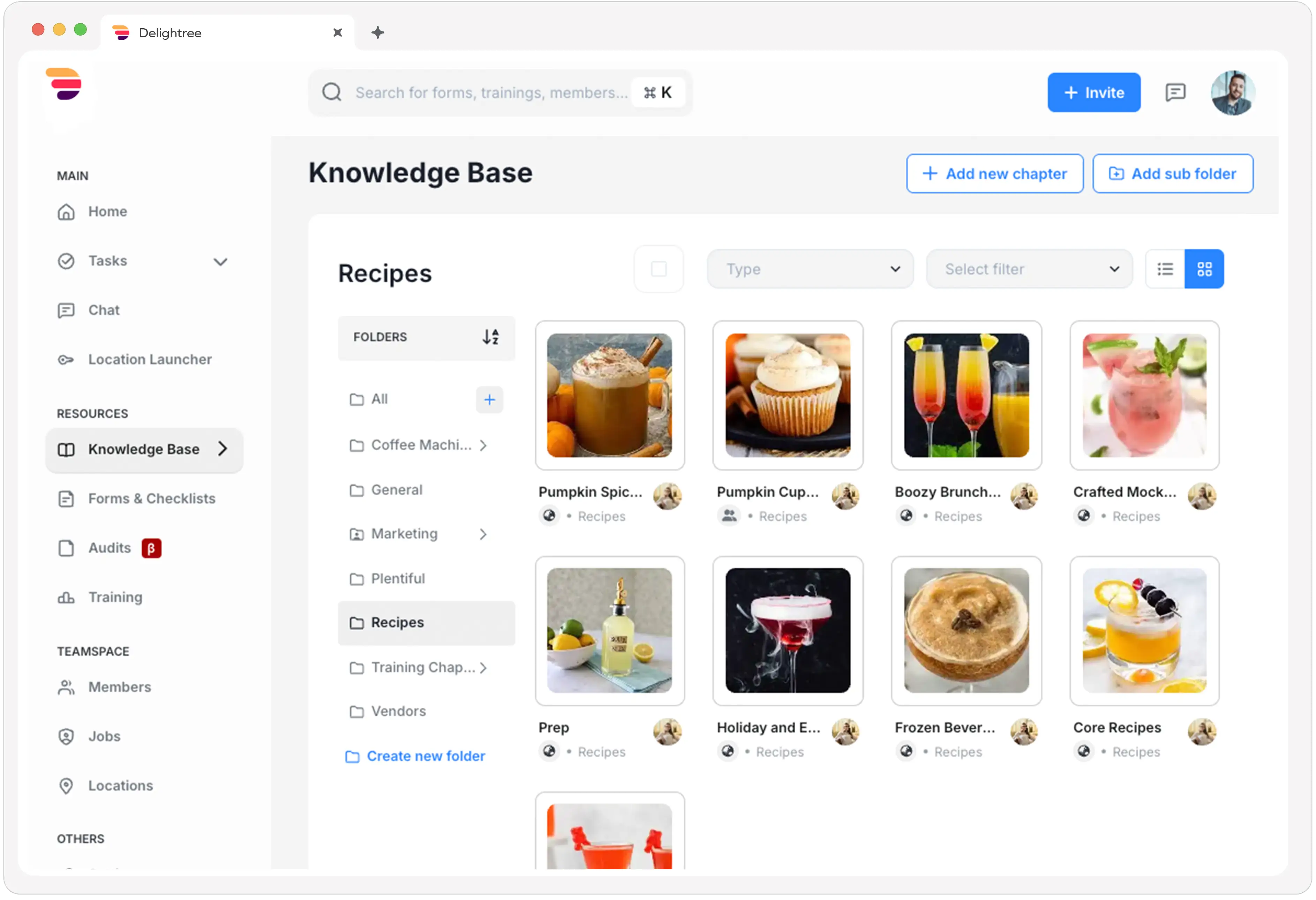
    Delightree knowledge base with version control and read receipts

Interactive Product Demo

About 3 minutes, no form. Open the full tour

Pricing

Flat rate per location with unlimited users and full feature access, so costs do not climb as each location adds staff. For a training buyer, this is the most consequential line in the comparison, because a franchise workforce that turns over several times a year costs nothing extra to keep trained. A per-seat LMS charges again for every replacement hire. Pricing requires a custom quote, and the three things that determine cost are the number of locations, the length of the agreement, and your growth plans.

Integrations

Delightree connects natively with Zapier, QuickBooks, HubSpot, and Zenoti for wellness and beauty points of sale, with Zapier covering systems that have no native connector. For a training evaluation, the connection that matters most is human resource information systems and payroll, because roster and role changes are what keep assignments accurate without manual admin. Confirm how that will work with your own system before you sign.

Setup

Most franchise rollouts are measured in months. A smaller network with an HQ team that stays responsive through onboarding can go live in weeks, but that is not typical. You are not starting from nothing. Existing SOPs, documents, photos and videos are brought into the knowledge base and structured into training and checklists during onboarding, handled by Delightree’s own customer success team.

Tradeoffs

Delightree is a franchise operating system with training inside it and not a specialist LMS, and that shows in a few places. It does not bundle a managed instructional design service, so if you want a vendor team to build courses on your behalf rather than authoring them yourself with the no-code builder, factor that into your evaluation. Multilingual delivery is limited, which matters if your frontline is largely multilingual. By comparison, Opus Training auto-translates into 130+ languages. There is no large off-the-shelf content marketplace, so the content is yours to bring. Delightree has 4.6 stars on G2 and 4.6 on the App Store.

Mini Case Study

Slick City replaced five separate tools with one system and built a repeatable opening process as it scaled past 32 territories.

“Having documented daily checks that are completed and cleaning tasks that are documented has been a game changer. We can audit what’s been done or not been done, and from a risk standpoint, it’s been critical.”
Wade Powell, Chief Operating Officer, Slick City
Read the full case study

See how Delightree helps multi-location teams run their day-to-day operations. Try the workflow yourself without filling out a form, or book a demo tailored to how your brand operates.

Book a Demo
Ranked #2

Opus Training

Best for Multilingual Frontline Teams

Franchise Training Score: 8.0/10

Opus is a mobile-first frontline training platform built for restaurant, hospitality and service franchises, and it is the strongest pure training product in this guide. Customers include Shipley Do-Nuts across 340+ locations, Just Salad, Smashburger and Blaze Pizza. If your bottleneck is getting a high-turnover, multilingual hourly workforce to finish training at all, Opus is built for exactly that job.

Product Overview

Login by phone number removes the email barrier completely. A new hire scans a QR code and starts training in seconds, with no IT setup and no password resets. Lessons are short, media-rich and swipeable, and they auto-translate into more than 130 languages. In-person check-ins let a manager watch someone perform a task on the floor and mark them as passed or needing support in the app, which is real competence verification that goes beyond simple course completion. An AI module builder and Ask Opus round it out.

Pricing

Per location across three tiers, Core, Growth and Enterprise. Custom quotes only, with no public pricing and no free trial listed.

Integrations

HRIS and payroll connections for roster sync. Narrower than an enterprise LMS on SCORM support and content marketplaces.

Setup

Fast by design. QR code access means frontline onboarding needs no IT provisioning, and brands report going live more quickly than with a traditional LMS.

Tradeoffs

The scope is the limit, and that is deliberate. There are no compliance audits with corrective action workflows, no location launch management, and Ask Opus searches training materials only, not the full brand knowledge base, so a food safety SOP that was never built into a module, for example, cannot be retrieved. Task management only launched in April 2025 and is still immature. Android performance problems including freezing during modules were reported through 2025, which matters more here than elsewhere because mobile is the only way in.

Read the detailed comparison
Ranked #3

Operandio

Best for Training Alongside Food Safety

Franchise Training Score: 7.9/10

Operandio is a Melbourne-based operations platform for frontline teams, founded in 2019, and it is a more serious training product than its checklist reputation suggests. For a restaurant or hospitality franchise that wants training and food safety compliance running in the same system, it is the closest competitor to Delightree on this page.

Product Overview

A mobile-first LMS with quizzes, badges, learning pathways and certificates, an AI-powered course builder, and physical assessments that let a manager verify hands-on skills onsite. Around it sit digital checklists, brand audits and inspections with corrective action routing, HACCP-compliant food safety with temperature monitoring, a searchable knowledge base, communications, and supplier management. In February 2026, it acquired FranchiseLab, adding franchise recruitment.

Pricing

Custom quotes across Business and Enterprise tiers, with a 14-day free trial. Pricing combines locations, users and modules, so the per-user element is the part to model at frontline headcount.

Integrations

Adequate across the restaurant stack and thinner elsewhere. Check HRIS and payroll specifically if roster sync matters to you.

Setup

Weeks. Reviewers describe it as approachable for non-technical users, and the mobile-first design means frontline onboarding moves quicker than a traditional LMS rollout.

Tradeoffs

Operandio has 4.9 stars from 22 reviews on Capterra, which is a strong score on a thin base, so reference calls at your own size matter more than the score. It is a small company at roughly 15 employees, and reviewers note that feature requests can take a long time to ship. Its AI is limited to the course builder and does not search your brand knowledge, so a question that was never built into a module cannot be answered. It is hospitality-native rather than franchise-native, so nonfood brands run into restaurant assumptions, and franchisor and franchisee structure gets configured rather than inherited.

Read the detailed comparison
Ranked #4

World Manager

Best Franchise-Native LMS Inside a Suite

Franchise Training Score: 7.0/10

World Manager is the training and frontline platform inside FranConnect, and that is worth knowing before you evaluate it as a separate product. For brands already running FranConnect for franchise development and royalties, it is the path of least resistance for training, and it is genuinely franchise-native in a way most LMS products are not.

Product Overview

Training and brand standards modules built around the franchisor-franchisee relationship, with layered content permissions, cross-location reporting and franchisee-level visibility. Because it sits inside the FranConnect suite, training data can be viewed next to franchise development and compliance data rather than in a separate silo.

Pricing

Priced by module within the FranConnect suite, on a custom quote, with no published list price and no free tier. What you pay depends heavily on which other FranConnect modules you already take, which makes comparing it against a standalone LMS difficult.

Integrations

Inherits FranConnect’s integration surface, which is broad and enterprise-grade with an API.

Setup

Months rather than weeks if you buy it as part of a FranConnect implementation, usually with a dedicated project team. Faster if the suite is already in place.

Tradeoffs

Frontline adoption is the recurring complaint across the FranConnect estate, and reviewers point at usability as the cause, describing software that is clunky and overly complicated and hard enough for frontline staff to use that they stop using it. FranConnect has 4.3 stars from 203 reviews on Capterra, with ease of use at 4.2, below its customer service score of 4.5. Buying World Manager also means buying into FranConnect’s module and pricing model. If you are evaluating World Manager and FranConnect as two options, they are one company.

Read the detailed comparison
Ranked #5

Wisetail

Best for Branded Learning

Franchise Training Score: 6.3/10

Wisetail is a learning and frontline enablement platform for multi-unit restaurant, hospitality and retail brands, owned by Intertek Alchemy since 2017 and built around culture-driven content and heavy custom branding. GoTo Foods runs it across 6,900+ locations. If the goal is a training environment that feels like your brand rather than a generic LMS, this is the category leader for that.

Product Overview

A custom-branded learner experience, social learning and community features, gamification, SCORM support, AI translation, and a content authoring environment aimed at L&D teams who want control over look and feel. OnTrack adds task management as a separate product.

Pricing

Custom quotes, with third-party estimates starting around $1,000 per month. Implementation can reach $50,000 or more for large enterprises, and OnTrack task management costs extra on top.

Integrations

More than 50 integrations across HR, payroll and workplace tools, including ADP Workforce Now, BambooHR, Google Workspace and Gusto. SCORM and SSO supported.

Setup

Enterprise implementation with significant configuration, particularly around branding and content migration.

Tradeoffs

Wisetail has 4.2 stars from 49 reviews on G2, the lowest rating of the specialist LMS options here. The consistently documented gap is reporting, which reviewers describe as nearly unusable for quiz and test data, and that is a serious problem if your training records are your compliance evidence. Permissioning for large franchise organizations is cumbersome, and there are no audits, no corrective actions and no location launch tooling.

Read the detailed comparison
Ranked #6

Connecteam

Best for Training Bundled With Comms

Franchise Training Score: 6.0/10

Connecteam is a mobile-first workforce app that bundles training with scheduling, time tracking, chat and checklists. It comes up in franchise training evaluations because it is cheap to start, quick to adopt and genuinely built for phones, and because a single app covering four jobs is an easy thing to put to a franchisee council.

Product Overview

An HR and skills hub with AI-assisted course creation that turns a topic description into a course, alongside scheduling, GPS time tracking with payroll-ready timesheets, announcements, forms and task management. Frontline adoption tends to be strong because the app was designed for deskless teams first.

Pricing

A free plan covers up to 10 users with real functionality. Paid plans start at $29 per month for up to 30 users, with the Advanced tier at $49 and higher tiers reaching $99. Pricing is tiered by seat count, which is the constraint at franchise scale.

Integrations

Payroll and HR systems including the common providers. Thin on POS, booking and franchise-specific systems.

Setup

Days. The fastest deployment in this guide, with no implementation project.

Tradeoffs

The training module is light rather than a real LMS. There is no SCORM, no certification depth, and no competence verification beyond basic quizzes. Structurally, there is no franchisor-to-franchisee hierarchy, so corporate cannot lock in brand standards while franchisees add local content, and that separation is the architecture franchise training depends on. Reviewers often note that features they consider essential are only available with an upgrade, and that the jump from free to paid feels steep just past 10 users.

Read the detailed comparison
Ranked #7

LearningZen

Best for Emerging Franchise Brands

Franchise Training Score: 5.6/10

LearningZen is a franchise training LMS with location-based pricing, built-in course authoring, video hosting, and an optional instructional design team you can pay to build courses for you. That last part is genuinely useful for a small HQ team with no L&D function, and it is the clearest reason to consider it.

Product Overview

Course creation and delivery, video hosting, quizzes and assessments, completion tracking, starter templates, and organizing learners by location. The proposition is franchise-specific simplicity: enough structure to run consistent onboarding across locations without the configuration burden of an enterprise platform.

Pricing

Location-based tiers, which behaves well as a network grows. LearningZen does not publish current pricing, and historical third-party data suggests a range of roughly $399 to $999 per month. Support, onboarding and training are included, while API and SSO integrations are optional add-ons.

Integrations

Limited. API and SSO are paid add-ons rather than standard, so check HRIS and payroll against your stack before assuming roster sync.

Setup

Fast, with light configuration.

Tradeoffs

The public review base is very thin at four Capterra reviews with minimal G2 presence, which makes independent due diligence hard, and four reviews from a vendor’s happiest customers is not a representative sample. Tracxn records the company at seven employees as of April 2026, which is worth weighing if you are betting your training records on it. Reviewers describe the mobile interface as clunky and customization as restrictive, and report that migrating off the platform is difficult. There are no audits with corrective actions, no location launch management, no AI, and only minimal task management, so brands run it alongside separate systems for daily execution.

Read the detailed comparison
Ranked #8

Docebo

Best for Multi-Audience Enterprise

Franchise Training Score: 5.5/10

Docebo is a publicly traded enterprise LMS used by more than 3,900 organizations to train employees, partners and customers from one platform. It is in this guide because large franchise groups do shortlist it, and it is the strongest product here on pure learning depth. It is also the least franchise-native.

Product Overview

AI-driven content personalization and skills-based recommendations, a content marketplace with more than 30,000 off-the-shelf courses, a multi-portal architecture for separate audiences, native e-commerce, SCORM and xAPI, and an extensive integration ecosystem.

Pricing

Custom enterprise pricing, not published, with third-party estimates around $25,000 per year at entry. Add-on requirements are a recurring friction point in reviews.

Integrations

Extensive, including HRIS, CRM, SSO and Microsoft Teams. The strongest integration surface in this guide.

Setup

Enterprise implementation requiring dedicated L&D and IT resources. Reviewers consistently flag setup complexity as needing technical support.

Tradeoffs

Docebo has 4.3 stars from around 744 reviews on G2 and 4.4 from around 232 on Capterra, which is a deep and credible review base, though TrustRadius sits notably lower at 7.3 out of 10. For a franchise brand, the problem is fit rather than quality. There is no franchisor-to-franchisee hierarchy, no audits with corrective actions, no location launches, and portal domains cap at 10, which constrains multi-brand groups. It is a corporate learning platform being asked to do franchise work.

Read the detailed comparison
Ranked #9

Trainual

Best for SOP Documentation

Franchise Training Score: 5.3/10

Trainual is a process documentation and training platform for small and mid-sized businesses, and it is very good at the job it actually does. It appears in franchise training evaluations because documenting the playbook is genuinely Step One, and Trainual is usually the tool that gets a brand out of Google Docs. It has 4.8 stars from 500+ reviews on Capterra.

Product Overview

SOP and process documentation in a structured editor, role-based training assignment, onboarding checklists, a searchable knowledge base, quizzes, a Chrome extension that surfaces training notes inside other tools, and AI Assist for drafting content and answering questions from published material with a link to the source. Content creation with rich media is smooth and the learning curve for admins is low.

Pricing

Trainual no longer publishes per-plan pricing on its website and directs inquiries to a demo. Third-party sources report roughly $249 to $419 per month depending on headcount band, billed annually, with enterprise custom, and a free trial is available. Because pricing is tied to headcount, costs rise as you add employees even when usage does not increase.

Integrations

Moderate and weighted toward HR and identity systems. Reviewers note that some connections require a Zapier workaround.

Setup

The software configures quickly, but that is not the real timeline. Gathering and structuring a brand’s existing training documents is the actual work, and franchisees typically need weeks to collect what is needed.

Tradeoffs

There are no audits, no task management and no location launch capability, so Trainual cannot run franchise-level execution. It was designed for a single business documenting its processes rather than a franchisor enforcing standards across a network it does not employ. One Capterra reviewer put it plainly, writing that the product is very much tailored for small businesses and can be challenging to scale across organizations with multiple operators such as franchisees. The mobile app lags the desktop experience, and quiz functionality is limited.

Read the detailed comparison

How We Built This Guide

Franchise training buyers are usually trying to solve three problems at once. They need an hourly workforce with no company email to actually finish training. They need evidence of competence that holds up in front of a regulator or a franchise attorney. And they need the training that follows a failed standard to actually get assigned, rather than being noticed by nobody and closed by no one.

We assessed 9 platforms during August 2026 against six weighted criteria. Where a vendor does not publish pricing, we say so instead of estimating. Where a review base is thin, we flag it, because 4.9 from 22 reviews and 4.3 from 744 are not the same signal, and four reviews is not a sample at all.

This guide is for Heads of Training, Directors of Learning and Development, and Vice Presidents and Directors of Operations at franchisor HQ teams supporting roughly 10 to 300 locations. At brands under 30 locations, the founder or Chief Operating Officer usually owns this decision directly. It is not written for corporate L&D teams training desk-based employees.

How to Choose Franchise Training Software That Will Actually Get Used

  1. Step 1: Separate documentation, learning delivery, and operational verification

    These are three different products and most brands need more than one. Documentation captures the SOP. Learning delivery teaches it. Operational verification proves the location did the training. Write down which of the three is failing right now, so you can make sure you’re getting the right tool for your specific problem.

  2. Step 2: Check how a frontline employee logs in without a company email

    Ask the vendor to show you a new hire getting into training with no email address, no IT setup and no password. If the answer involves creating accounts centrally, your completion rate will track your admin capacity rather than your training need.

  3. Step 3: Model cost per learner against cost per location at your real turnover rate

    Take your actual annual turnover and your headcount per location, then build the three-year bill. Per-seat pricing charges you again for every replacement hire, and at franchise turnover rates, that is not a rounding difference.

  4. Step 4: Test mobile completion during a real shift, not in a desktop demo

    Have someone finish a module on a phone during a busy period, and offline if your locations have poor signal. Lesson length, video load time and how the app behaves when a shift interrupts it are better indicators for eventual completion than content quality is.

  5. Step 5: Confirm training is assigned by role and location, not by named person

    An assignment tied to an individual dies when that individual leaves, and in a franchise workforce, that happens constantly. Assignment by role and location survives turnover and keeps the record continuous.

  6. Step 6: Check version control between the SOP and the course

    Ask what happens to the course when HQ publishes v2 of the underlying procedure. If the answer is that someone rebuilds the module by hand, you will eventually train a location on a standard that no longer exists, and your training records become evidence against you.

  7. Step 7: Trace a failed standard back to a retraining assignment

    Take a real finding from your last field visit and walk it through each demo. Who notices, who decides which course applies, who assigns it, and who confirms it landed. Count the systems and the manual steps.

  8. Step 8: Check multilingual delivery and how good the translation actually is

    Coverage claims range from a handful of languages to more than 130. Ask for the actual list, ask whether translation is automatic or manual, and have a native speaker on your team read a translated module.

  9. Step 9: Look at reporting you could put in front of a franchisee advisory council

    Council members resist anything that adds unpaid work at the location. Reporting that shows a franchisee their own performance, scoped so they only see their own units, changes that conversation faster than any feature demo.

  10. Step 10: Confirm HRIS and payroll sync for roster changes

    If new hires and role changes do not flow in automatically, someone at HQ is maintaining the roster by hand, and assignment accuracy starts decaying from the day you go live.

  11. Step 11: Scope content migration and ask who rebuilds the courses

    Migration worry stalls more of these deals than any competitor does. Get a written scope, including what transfers, what has to be rebuilt, who does the rebuilding, how long you run two systems, and what it costs. Ask specifically whether historical completion records come across, because those are your compliance history.

  12. Step 12: Ask whether the vendor will build courses for you

    Some platforms offer a managed instructional design service and some expect you to author everything yourself. If your HQ team has no L&D function, that difference matters more than most feature comparisons, and it is worth pricing before you shortlist.

Franchise Training Software Pricing Models Compared

Three models dominate, and at franchise turnover rates, the difference between them is not marginal.

Per user or per headcount band. Trainual, Docebo, Wisetail and Connecteam all price this way to some degree. Every hire increases the bill, and franchise workforces replace a large share of their people every year, so you pay repeatedly to train the same seat.

Per module inside a suite. World Manager sits here, priced within FranConnect. The training number depends on which other modules you take, which makes it almost impossible to compare against a standalone LMS unless you get the full module list and exclusions in writing.

Per location. Delightree, Opus and LearningZen all price per location. Delightree includes unlimited users and full feature access, so turnover costs nothing extra. Opus prices per location across three quote-only tiers, and LearningZen uses location-based tiers it does not currently publish. The bill tracks locations rather than people, which is the model that matches how a franchise actually grows.

Run the arithmetic at your own numbers. A 50-location brand with 15 staff per location and 100% annual turnover is training 750 people a year, and 1,500 over two. That is a very different conversation from a flat per-location fee, and the usual response to a rising per-seat bill is to cut access, which is the same thing as cutting completion.

Questions worth asking about cost

  • Is pricing per user, per location, or per module, and what triggers a move to a higher tier?
  • What happens to the bill when we add locations mid-term, or when a location closes?
  • Are certifications, translations, SCORM support and reporting included or charged separately?
  • What are the implementation and content migration fees, and who does the rebuilding?
  • Is there a managed instructional design service, and what does it cost?
  • How long do we run two systems during migration?
  • What is the contract term, and is there an out clause?
  • Our technology fee is not in our FDD yet. How do other brands handle that?
  • Can we pilot in a few locations before signing?

Key Features to Look For in Franchise LMS and Training Software

  1. A versioned SOP library that the courses are built from

    If the course and the procedure live in different systems, they will drift apart, and a v1 course teaching a v2 standard is worse than no course at all. Look for training generated from a single versioned source, so an update reaches everywhere it is referenced.

  2. Assignment by role and location rather than by named person

    Named assignments die with turnover. Assigning by role and location means a replacement hire inherits the right training path automatically, and the completion record stays continuous through the churn.

  3. Mobile delivery that does not need a company email address

    Most franchise frontline staff do not have a company email. QR code or phone number access removes the biggest single barrier between a new hire and their first module, and it takes IT out of the critical path.

  4. Microlearning sized for a shift

    Nobody finishes a 40-minute course between a lunch rush and a delivery. Short, media-rich lessons that survive being interrupted are what turn into actual completion.

  5. Multilingual delivery you have actually checked

    Coverage claims vary from a handful of languages to more than 130. What matters is whether a native speaker on your team would understand the translation, so test it before you trust the number.

  6. Competence checks and certification tracking

    A completion percentage does not satisfy a regulator. Look for manager sign-off, photo evidence, or in-person checks that show the job was done properly, plus tracking of when certifications expire.

  7. Retraining that can be triggered by an audit finding

    The gap between a finding and the training that fixes it is where repeat findings come from. Look for a route from a failed standard to an assigned course without anyone having to export anything.

  8. Separate onboarding paths for new hires and new franchisees

    A franchisee learning to run a business and a crew member learning to close are different curricula with different stakes. A platform that treats them as one path will underserve both.

  9. Completion and engagement reporting by location

    Averages hide the locations that are failing. You need to be able to name the location that has not opened the app this week, not read a network completion figure that looks acceptable.

  10. AI search over your approved operating content

    Training covers what you anticipated. AI search across the full brand knowledge base covers what you did not, and returning the source document is what makes the answer trustworthy in the middle of a shift.

150+ franchise brands

See how Delightree runs a multi-unit network

See how Delightree helps multi-location teams run their day-to-day operations. Try the workflow yourself without filling out a form, or book a demo tailored to how your brand operates.

“Having documented daily checks that are completed and cleaning tasks that are documented has been a game changer. We can audit what’s been done or not been done, and from a risk standpoint, it’s been critical.”
Wade Powell, Chief Operating Officer, Slick City

Frequently Asked Questions

What is franchise training software and how does it work?

Franchise training software delivers and tracks training across locations a franchisor does not directly employ. Unlike a general LMS, it handles the franchisor-franchisee relationship, with layered content permissions where corporate locks in brand standards and franchisees add local content, cross-location reporting, and access that works for staff without a company email address.

What is the difference between a franchise LMS and franchise training software?

In practice, the terms are used interchangeably. The useful distinction is scope. An LMS delivers and tracks courses. Franchise training software adds the franchise layer, including multi-tier permissions, location-level reporting, and in the strongest cases, a route from a failed brand standard back to the training that fixes it.

How do you deliver training to hourly staff with no company email address?

The leading platforms remove the email requirement entirely. Opus uses QR code and phone number access so a new hire starts training in seconds, and Delightree scopes access by role and location inside one mobile app. If a vendor needs accounts created centrally, your completion rate becomes a function of how much admin capacity HQ has.

Can Delightree show competence rather than just course completion?

Training completion sits in the same data layer as audit scores, task completion and site visit results, so a franchisor can see whether a trained location actually meets the standard. A failed audit item becomes a corrective action task, the relevant training can be assigned to that team from the audit screen, and a follow-up visit can be triggered to check the fix.

How do you keep courses in step when an SOP changes?

Look for training generated from a versioned knowledge base rather than authored separately. In Delightree, every SOP lives in one Knowledge Base and an update propagates across Training, Tasks and Audits rather than leaving stale copies behind. Platforms where courses are authored independently need someone to rebuild the module by hand.

Does Delightree support multiple languages for frontline teams?

Multilingual delivery is limited, and that is a genuine tradeoff. If your frontline workforce is largely multilingual, Opus Training auto-translates into more than 130 languages and is the stronger choice on that specific point. Delightree is the stronger choice where training needs to connect to audits, tasks and location openings.

What training records does franchise training software keep for audits and inspections?

At minimum, who completed what and when, by location and role. What separates the strong platforms is evidence of competence beyond completion: manager sign-off, photo evidence, in-person checks, and tracking of when certifications expire. A completion percentage on its own rarely satisfies a regulator or a franchise attorney.

Do you still need a standalone LMS if your operations platform includes training?

Often not, and consolidating is usually the point, because franchisees will not log into four systems. Brands typically keep a standalone LMS only where they need SCORM or xAPI compliance, a large off-the-shelf content library, or separate portals for customers and partners. If your training is your own brand standards delivered to your own network, an operations platform with training built in removes a login your franchisees were not opening anyway.

Which franchise training platforms will build the courses for you?

LearningZen offers an optional instructional design team, which is genuinely useful for a small HQ with no L&D function. Most others expect you to author your own content, though Delightree, Operandio and Opus all include AI-assisted course builders that reduce the work. Delightree does not bundle a managed instructional design service, so factor that in if you need one.

How long does it take to migrate training content to a new platform?

It depends on how much transfers and how much has to be rebuilt, and that is the question to get answered in writing. Ask what formats import, whether historical completion records come across, who does the rebuilding, and how long you run both systems. Migration effort can stall a deal s, and some platforms are documented as difficult to leave.

More Franchise Operations Resources

The product names, logos, and brands referenced on this page are the property of their respective owners. Delightree is not affiliated with, endorsed by, or sponsored by any other company named here. This page reflects Delightree's opinions and is based on publicly available information believed to be accurate as of August 2026. Competitor pricing and features change frequently; confirm current details on each provider's official website before making a purchasing decision.