Best Guru Alternatives in 2026

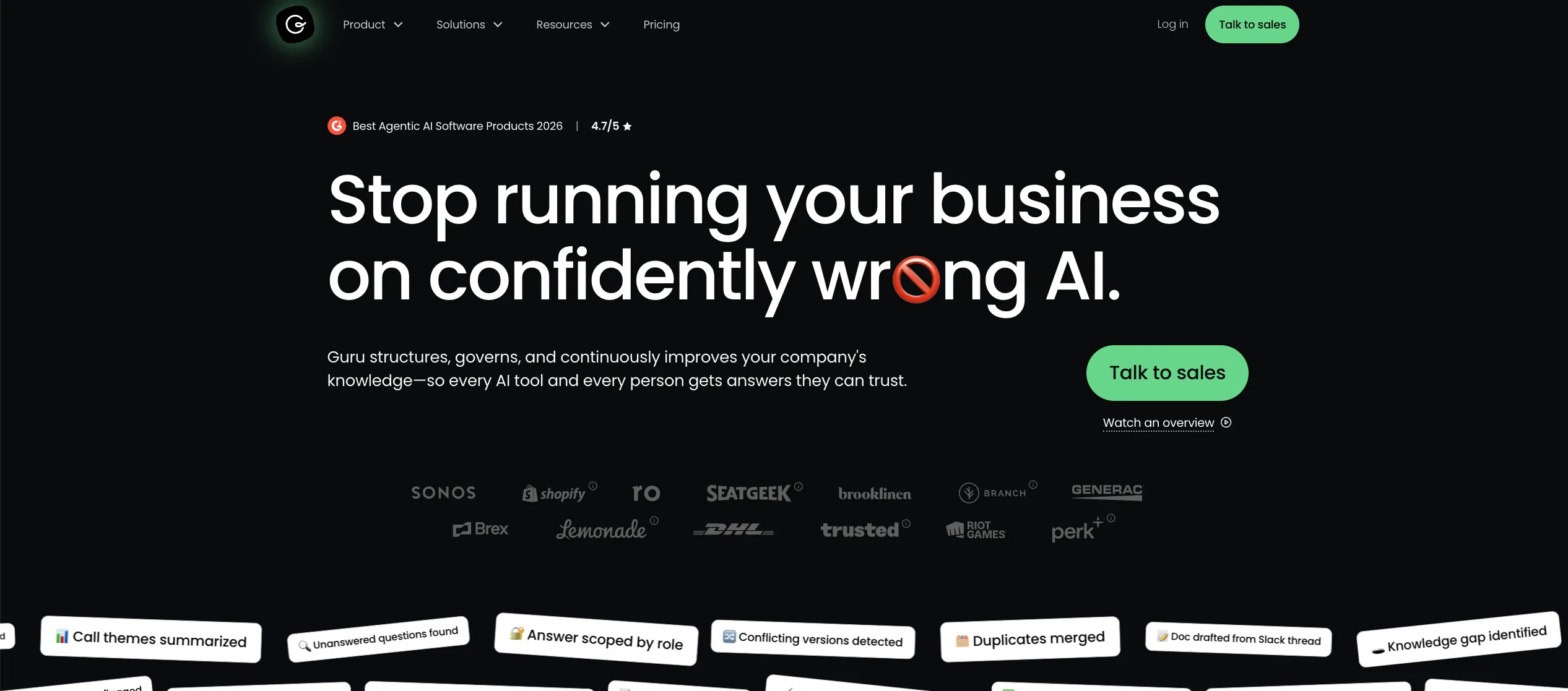
Guru is one of the strongest AI-powered knowledge management platforms available. Its verification workflows, contextual browser extension, and AI search make it excellent for customer support and sales teams who need instant access to verified company information. The ratings reflect that: 4.7/5 on both Capterra and G2, with 1,900+ G2 reviews representing a large and satisfied user base.

For franchise operations, the fit is narrower. Guru is a knowledge tool for knowledge workers, not a platform built for frontline hourly teams. Per-user pricing compounds significantly when applied to a franchise network with dozens or hundreds of locations. There is no training module for delivering microlearning to frontline workers. The browser extension model, which surfaces knowledge while a user works in Salesforce or Zendesk, does not translate to frontline workers on a mobile app. And Guru lives alongside separate tools for training, tasks, and audits rather than replacing them.

This page compares five options so franchise brands can find the knowledge management approach that fits how their networks actually operate.

Why Teams Switch from Guru

Per-user pricing for frontline access

Knowledge workers and hourly franchise team members are fundamentally different audiences. For a corporate office team of 20 using Guru to support customers, per-user pricing is manageable. For a franchise network with 50 locations averaging 15 frontline workers each, the math changes completely. At $10/user/month on the Starter tier, that is $7,500 per month for frontline access to a knowledge base. Delightree's per-location pricing eliminates that compounding entirely.

Knowledge without action

Guru stores and surfaces knowledge. It does not deliver training, assign tasks, trigger corrective actions after a failed audit, or connect to the operational execution layer of a franchise network. A franchise brand using Guru still needs a separate training platform, a separate task management tool, and a separate audit tool. Each of those integrations requires maintenance, and the data from each lives in a different system, making cross-module insights impossible without additional tooling.

No franchise architecture

Guru does not have a franchisor/franchisee permission hierarchy. Content governance in Guru is built around teams and workspaces, which can be configured for departmental access control. But the concept of a franchisor publishing brand standards that franchisees can see but not edit, with frontline workers seeing only the content relevant to their role, is not native to Guru's architecture. Franchise brands need that structure to govern content correctly at network scale.

Browser extension model does not fit frontline

Guru's primary delivery mechanism for surfacing knowledge contextually is a browser extension that detects what a user is doing in another app (Salesforce, Zendesk, Intercom, Gmail) and surfaces relevant cards automatically. That is a smart design for office-based knowledge workers. Frontline franchise workers are not in Salesforce. They are on a mobile app, at a point-of-sale terminal, or working a station. The delivery model does not match the environment.

<style> .dt-alt-table{width:100%;border-collapse:separate;border-spacing:0;border:1px solid #E5E7EB;border-radius:12px;overflow:hidden;font-family:Inter,sans-serif;font-size:16px;line-height:1.55} .dt-alt-table thead th{font-family:"Tasa Orbiter",sans-serif;font-size:18px;font-weight:700;text-align:left;padding:18px 20px;border-bottom:2px solid #E5E7EB;background:#F9FAFB;color:#111827} .dt-alt-table thead th.dt-rec{background:#f1b063;color:#FFF;position:relative} .dt-alt-table thead th.dt-rec::after{content:"Recommended";display:block;font-size:11px;font-weight:600;letter-spacing:.04em;text-transform:uppercase;color:rgba(255,255,255,.8);margin-top:2px} .dt-alt-table tbody td{padding:16px 20px;vertical-align:top;border-bottom:1px solid #E5E7EB;color:#4B5563} .dt-alt-table tbody tr:last-child td{border-bottom:none} .dt-alt-table tbody td:first-child{font-family:"Tasa Orbiter",sans-serif;font-size:17px;font-weight:700;color:#111827;white-space:nowrap} .dt-alt-table tbody td.dt-hl{background:#FDF6EC;color:#111827;font-weight:500} .dt-alt-table tbody tr:hover{background:#FAFAFA} </style><table class="dt-alt-table"> <thead> <tr> <th>Feature</th> <th class="dt-rec"><strong>Delightree</strong></th> <th>Guru</th> <th>Notion</th> <th>Confluence</th> <th>Document360</th> </tr> </thead> <tbody> <tr> <td><strong>Best for</strong></td> <td class="dt-hl">Franchise brands, multi-unit operators</td> <td>Customer support and sales teams</td> <td>Teams wanting flexible wikis</td> <td>Technical/software teams</td> <td>External help centers and documentation</td> </tr> <tr> <td><strong>Pricing</strong></td> <td class="dt-hl">Per location, unlimited users</td> <td>Free (3 users), $10/user/mo Starter, $14/user/mo Builder</td> <td>Free to $16/user/mo</td> <td>Free to $8.15/user/mo</td> <td>From $149/project/mo</td> </tr> <tr> <td><strong>AI knowledge search</strong></td> <td class="dt-hl">Yes, grounded in brand content with source links</td> <td>Yes, strong AI search</td> <td>Limited</td> <td>Limited</td> <td>Yes, for published docs</td> </tr> <tr> <td><strong>Knowledge base/wiki</strong></td> <td class="dt-hl">Yes, structured for franchise SOPs</td> <td>Yes, cards-based</td> <td>Yes, flexible databases</td> <td>Yes, pages and spaces</td> <td>Yes, external-facing</td> </tr> <tr> <td><strong>Training/learning</strong></td> <td class="dt-hl">Yes, with microlearning and completion tracking</td> <td>No</td> <td>No</td> <td>No</td> <td>No</td> </tr> <tr> <td><strong>Task management</strong></td> <td class="dt-hl">Yes, franchise-native</td> <td>No</td> <td>Limited (database views)</td> <td>No</td> <td>No</td> </tr> <tr> <td><strong>Franchise-native</strong></td> <td class="dt-hl">Yes (franchisor/franchisee hierarchy)</td> <td>No</td> <td>No</td> <td>No</td> <td>No</td> </tr> <tr> <td><strong>Mobile experience</strong></td> <td class="dt-hl">Native mobile app, frontline-optimized</td> <td>Mobile web, extension-dependent</td> <td>Mobile app (limited)</td> <td>Mobile app (limited)</td> <td>No frontline mobile</td> </tr> <tr> <td><strong>Verification/governance</strong></td> <td class="dt-hl">Content update governance, version control</td> <td>Yes, card verification workflow</td> <td>Manual, no governance</td> <td>Page history, no verification</td> <td>Yes, publish workflows</td> </tr> <tr> <td><strong>Free tier</strong></td> <td class="dt-hl">No</td> <td>Yes (up to 3 users)</td> <td>Yes</td> <td>Yes (up to 10 users)</td> <td>No</td> </tr> </tbody> </table> <blockquote> <p>Delightree is the Recommended platform for franchise brands. Pricing is per location with unlimited users.</p> </blockquote>
<h3>1. Delightree (Recommended)</h3> <p>Delightree is a franchise management OS built specifically for the franchisor/franchisee relationship. The Knowledge Base, Training, AI Search, Tasks and Checklists, Site Visits, Location Launcher, Support Tickets, and Forms all share a single data layer. For a franchise brand evaluating knowledge management tools, the relevant question is not just "where do we store our SOPs?" but "how do our SOPs connect to training, audits, and operational execution?" Delightree is the answer to that broader question.</p> <p><strong>Knowledge Base as single source of truth.</strong> The Knowledge Base in Delightree is structured for franchise SOPs: organized, version-controlled, and searchable. When a brand standard changes, it updates everywhere it appears. Franchisees are always reading the current version. There is no "which folder has the updated SOP" problem and no "someone else's edit broke the content" problem. Content governance is built into the structure of the platform.</p> <p><strong>Franchise-native mobile app with proper permission hierarchy.</strong> The Delightree mobile app delivers the right content to the right person based on their role in the franchise hierarchy. A frontline team member sees their training modules, tasks, and relevant SOPs. A franchisee sees location-level performance and operational data. A franchisor sees the full network view. The permission hierarchy is structural, covering four distinct tiers: franchisor, franchisee, manager, and frontline.</p> <p><strong>No-code content builder for training.</strong> Franchise operations teams should not need an instructional design team to build training. The no-code content builder in Delightree lets operations staff create courses, assessments, and structured learning paths without technical help. Content can be updated and republished quickly when brand standards change.</p> <p><strong>Microlearning with vertical video.</strong> A 2024 study found that 85% of employees prefer microlearning over traditional training modules. Delightree delivers training as short, focused lessons including vertical video in the format frontline workers already consume daily. For hourly workers who clock in and do their job, a 90-second video that teaches one thing drives better retention and completion rates than a 45-minute module.</p> <p><strong>AI Search that works from brand content.</strong> When a worker types a question in Delightree, the AI Search retrieves the answer from the brand's actual content and returns a source link. This is the distinction from generic AI tools: the answers come from what the brand has published, not from the internet. A franchisee asking about the correct procedure for handling a specific situation gets the brand's answer, with attribution, on mobile, within the same app where they do their training and tasks.</p> <p><strong>All-in-one platform with data correlation.</strong> Because Knowledge Base, Training, AI Search, Tasks and Checklists, Site Visits (Audits), Location Launcher, Support Tickets, and Forms all share a data layer, Delightree can surface correlations that separate tools cannot see. Training completion rates can be compared against audit scores to identify locations where learning gaps are driving compliance failures. Support ticket volume can be tracked against training gaps to find topics generating operational confusion. Onboarding procedure adherence can be compared against first-year audit results to validate whether the launch process is working. These insights require all of the data to live in one system.</p> <p><strong>Pricing.</strong> Delightree is priced per location with unlimited users. For franchise networks with variable team sizes and high frontline turnover, this model is significantly more predictable than per-user pricing at any tier.</p> <p><strong>One honest limitation.</strong> Guru's browser extension model for surfacing relevant knowledge while a team member is working in another app (Salesforce, Zendesk, Intercom, email) is a capability Delightree does not offer. For franchise corporate office teams who need knowledge surfaced contextually while doing customer support work, Guru's integration approach is more sophisticated.</p> <hr /> <h3>2. Guru</h3> <p>Guru is an AI-powered knowledge management platform combining a cards-based knowledge base, AI search, and a browser extension that surfaces relevant content while users work in other applications. The verification workflow is one of Guru's most distinctive features: content owners can mark cards as trusted/verified, and Guru flags stale content for review so knowledge bases stay current without manual audits. Ratings are strong: 4.7/5 on Capterra with 500+ reviews, 4.7/5 on G2 with 1,900+ reviews.</p> <p>For customer support and sales teams using Zendesk, Salesforce, or Intercom, Guru's context-aware surfacing is genuinely useful. A support agent handling a ticket can see relevant knowledge cards appear automatically based on the content of the conversation. That capability is built for office-based knowledge workers operating in browser-based tools. It is not a model that translates to frontline franchise workers on mobile apps in physical locations.</p> <p><strong>Limitations:</strong><br /> - Per-user pricing compounds significantly for frontline franchise networks<br /> - Designed for knowledge workers, not hourly frontline teams<br /> - No training module or microlearning delivery<br /> - No franchise permission hierarchy (franchisor/franchisee/manager/frontline)<br /> - No task management or audit capability<br /> - No location launch management<br /> - Browser extension model does not fit mobile-first frontline workflows<br /> - Requires separate tools for training, tasks, and audits</p> <p><strong>Verdict:</strong> Guru is the best AI-powered knowledge management platform for office-based customer support and sales teams. For franchise brands, it is a strong knowledge tool that still requires a separate training platform, task management tool, and audit tool alongside it. Per-user pricing makes network-wide frontline access expensive.</p> <hr /> <h3>3. Notion</h3> <p>Notion is a flexible workspace tool that combines documents, databases, wikis, and project management in one interface. Teams use it to build internal knowledge bases, project trackers, meeting notes, and product documentation. The flexible database structure allows for highly customized information architecture, which makes Notion appealing for teams that want to design their own system. Capterra rating is 4.7/5, and pricing ranges from free to $16/user/month.</p> <p>For franchise operations, Notion's flexibility is also its limitation. Building a structured franchise knowledge base in Notion requires significant configuration. Governance is manual: there are no native content verification workflows, no flagging of stale content, and no franchise permission hierarchy. There is no training delivery capability, no audit or inspection functionality, and no task management tied to operational execution. A franchise brand using Notion for knowledge management is configuring a general-purpose tool rather than working within a system designed for franchise operations.</p> <p><strong>Limitations:</strong><br /> - No native franchise permission hierarchy<br /> - No training module or microlearning delivery<br /> - No audit or compliance functionality<br /> - No location launch management<br /> - No AI search within brand-specific content<br /> - Content governance is manual, no verification workflows<br /> - Per-user pricing for frontline teams</p> <p><strong>Verdict:</strong> Notion is a powerful flexible wiki and knowledge tool for teams comfortable with database-style information architecture. It is a stronger structured knowledge base than Google Drive for teams willing to invest in configuration, but it still requires separate tools for training, tasks, and audits.</p> <hr /> <h3>4. Confluence (Atlassian)</h3> <p>Confluence is Atlassian's team wiki and documentation platform, widely adopted in software development and technical teams as a companion to Jira. It offers pages, spaces, templates, and a reasonably structured knowledge organization model. Deep integration with the Jira ecosystem makes it the default documentation tool for engineering and product teams. Capterra rating is 4.3/5, and pricing ranges from free (up to 10 users) to $8.15/user/month.</p> <p>For franchise operations, Confluence is designed for technical teams and becomes complex for non-technical users. The page-and-space model requires deliberate governance to stay organized, and without that governance, large wikis become difficult to navigate. There is no training delivery capability, no audit functionality, and no franchise permission hierarchy. For non-technical franchise operations teams, the UI and terminology borrowed from software development (spaces, macros, templates) create a learning curve that reduces adoption among frontline workers and franchisees.</p> <p><strong>Limitations:</strong><br /> - Complex interface for non-technical users<br /> - No training module or microlearning delivery<br /> - No audit or compliance functionality<br /> - No franchise permission hierarchy<br /> - No AI search within brand-specific content<br /> - Per-user pricing for frontline teams<br /> - Best suited for Jira-integrated technical teams, not franchise operations</p> <p><strong>Verdict:</strong> Confluence is the right documentation tool for technical and product teams embedded in the Atlassian ecosystem. It is not designed for frontline franchise operations teams, and adoption outside of technical contexts is typically low.</p> <hr /> <h3>5. Document360</h3> <p>Document360 is a knowledge base platform built primarily for external documentation and customer-facing help centers. It is used by software companies and SaaS products to publish help documentation, API references, and product guides that customers can access publicly. Capterra rating is 4.7/5, and pricing starts at $149/project/month. The platform has strong publishing workflows, a versioning system, and analytics for tracking which articles are read.</p> <p>For franchise operations, Document360's external documentation focus is the core limitation. It is designed for publishing knowledge to customers, not for managing internal franchise operational knowledge across a network. There is no franchise permission hierarchy, no training delivery, no task management, and no audit capability. The pricing model (per project) also does not align with franchise network structures where the relevant unit of organization is a location, not a documentation project.</p> <p><strong>Limitations:</strong><br /> - Built for external customer-facing documentation, not internal franchise operations<br /> - No franchise permission hierarchy<br /> - No training module or microlearning delivery<br /> - No task management or audit functionality<br /> - Per-project pricing does not align with franchise network structure<br /> - No mobile-first frontline experience<br /> - Not designed for structured internal operational knowledge</p> <p><strong>Verdict:</strong> Document360 is a strong choice for SaaS companies and software products that need to publish external help documentation. It is not designed for internal franchise operational knowledge management and does not cover training, tasks, or audits.</p>

How to Choose

The right platform depends on what your franchise network needs from a knowledge management tool and whether that tool needs to connect to training, tasks, and audits.

Choose Guru if: your primary use case is knowledge retrieval for an office-based customer support or sales team working in browser-based tools like Salesforce or Zendesk. Guru's AI search and browser extension are the best in class for that specific workflow, and the verification model keeps content trustworthy.

Choose Notion if: your team wants a highly flexible, customizable knowledge wiki and is willing to invest time in configuring a structure that works for your organization. Notion is better than Google Drive for structured knowledge management and can approximate a knowledge base with enough setup.

Choose Confluence if: your franchise corporate office is deeply embedded in the Atlassian ecosystem and your primary documentation audience is a technical team using Jira. For non-technical franchise operations teams, look elsewhere.

Choose Document360 if: your need is specifically external customer-facing documentation rather than internal franchise operational knowledge. For help centers and product documentation, Document360 is purpose-built.

Choose Delightree if: you need a franchise-native platform where the knowledge base connects to training, tasks, audits, and location management in one system. Knowledge in Delightree is not a separate tool living alongside your operational platform. It is the foundation that training content is built on, that AI search retrieves from, and that audits reference. Per-location pricing makes network-wide access predictable regardless of team size.

<style> .dt-faq-list{display:flex;flex-direction:column} .dt-faq-item{border-bottom:1px solid #E5E7EB} .dt-faq-item:first-child{border-top:1px solid #E5E7EB} .dt-faq-question{width:100%;background:none;border:none;text-align:left;padding:20px 40px 20px 0;cursor:pointer;font-family:"Tasa Orbiter",sans-serif;font-size:17px;font-weight:600;color:#111827;line-height:1.4;position:relative} .dt-faq-question:hover{color:#f1b063} .dt-faq-question::after{content:'';position:absolute;right:8px;top:50%;width:10px;height:10px;border-right:2px solid #6B7280;border-bottom:2px solid #6B7280;transform:translateY(-65%) rotate(45deg);transition:transform .3s ease} .dt-faq-item.dt-open .dt-faq-question::after{transform:translateY(-35%) rotate(-135deg);border-color:#f1b063} .dt-faq-item.dt-open .dt-faq-question{color:#f1b063} .dt-faq-answer{max-height:0;overflow:hidden;transition:max-height .35s ease} .dt-faq-item.dt-open .dt-faq-answer{max-height:600px} .dt-faq-answer p{margin:0;padding:0 0 20px;font-size:16px;line-height:1.7;color:#4B5563} </style><h2>Frequently Asked Questions</h2> <div class="dt-faq-list"> <div class="dt-faq-item"><button class="dt-faq-question" onclick="this.parentElement.classList.toggle('dt-open')">1. What is the best Guru alternative for franchise brands?</button><div class="dt-faq-answer"><p>Delightree is the strongest alternative for franchise brands. Guru is designed for knowledge workers on office-based teams, not frontline hourly workers in franchise locations. Delightree includes a Knowledge Base, Training, AI Search, Tasks and Checklists, Site Visits, Location Launcher, Support Tickets, and Forms in a single franchise-native platform, with per-location pricing that does not compound with team size.</p></div></div> <div class="dt-faq-item"><button class="dt-faq-question" onclick="this.parentElement.classList.toggle('dt-open')">2. How much does Guru cost?</button><div class="dt-faq-answer"><p>Guru offers a free tier for up to 3 users. Paid plans start at $10/user/month (Starter, 3-user minimum) and $14/user/month (Builder). Enterprise pricing is custom. For a franchise network with frontline workers at multiple locations, per-user pricing compounds significantly. Delightree prices per location with unlimited users, which is more predictable for franchise networks.</p></div></div> <div class="dt-faq-item"><button class="dt-faq-question" onclick="this.parentElement.classList.toggle('dt-open')">3. Can Guru manage franchise knowledge management?</button><div class="dt-faq-answer"><p>Guru can manage a knowledge base and surface information to teams using its AI search. However, it does not have a franchise permission hierarchy (franchisor/franchisee/manager/frontline), no training delivery module for frontline workers, no task management or audit capability, and no location launch management. Franchise brands using Guru still need separate tools for training, tasks, and audits, and the per-user pricing scales unfavorably for frontline team access.</p></div></div> <div class="dt-faq-item"><button class="dt-faq-question" onclick="this.parentElement.classList.toggle('dt-open')">4. What does Guru lack for franchise operations?</button><div class="dt-faq-answer"><p>Guru lacks: a franchise-native permission hierarchy, training delivery and microlearning capabilities, task management tied to operational execution, audit and site visit functionality, location launch management, and a per-location pricing model. Guru's browser extension model for surfacing knowledge contextually also does not translate to mobile-first frontline workers in physical locations.</p></div></div> <div class="dt-faq-item"><button class="dt-faq-question" onclick="this.parentElement.classList.toggle('dt-open')">5. What is the difference between Guru and Delightree?</button><div class="dt-faq-answer"><p>Guru is an AI-powered knowledge management platform for office-based customer support and sales teams. Delightree is a franchise management OS that includes Knowledge Base, Training, AI Search, Tasks and Checklists, Site Visits (Audits), Location Launcher, Support Tickets, and Forms in a single platform with a franchise-native permission hierarchy. Guru is priced per user; Delightree is priced per location with unlimited users. Guru surfaces knowledge via browser extension; Delightree delivers knowledge, training, and AI search through a mobile-first app designed for frontline workers.</p></div></div> </div>
<p>If your franchise network needs knowledge management that connects to training, audits, and operational execution rather than a standalone knowledge tool, Delightree is the starting point.</p> <p><strong><a href="https://www.delightree.com/demo">Book a demo with Delightree</a></strong></p>